
A high-converting B2B prospect list is a targeted sales list built from verified contacts, current company data, buyer intent signals, firmographic fit, technographic fit, and trigger events. Unlike generic lead lists, it helps GTM teams prioritize accounts. These accounts are more likely to enter the pipeline.
Most sales teams don’t have a lead problem. They have a list of problems.
Every SDR team has pulled 5,000 contacts from a database at some point. They load the contacts into a sequencer. Then they watch open rates crawl. Reply rates flatline. Bounce rates climb into double digits. The activity looks busy. The pipeline doesn’t move.
When leadership asks why outbound isn’t working, reps rarely lack effort. The real issue is usually the list itself. The B2B prospect list was never built to convert.
A B2B prospect list is not just a spreadsheet of names and titles. It’s a hypothesis about who is most likely to buy. Like any hypothesis, it’s only as good as the data behind it.
The difference between an ignored list and a pipeline-filling list comes down to seven data signals. Get these right, and a lean SDR team can outperform a much larger one. This guide breaks down each signal. It shows you how to combine them into one workflow. It also shows how a modern sales intelligence platform like Revnos.AI brings all seven together.
Why Most B2B Prospect Lists Fail to Convert
Three problems explain most failed B2B prospect lists.
The Data Is Stale
People change jobs constantly. Titles get updated. Companies get acquired. Phone numbers get reassigned. A list pulled six months ago has already decayed. B2B contact databases can degrade by 30% or more per year. A list built on old data isn’t really a B2B prospect list. It’s a guess.
The Targeting Is Too Broad
“VP of Marketing at companies with 100+ employees” is not an Ideal Customer Profile. It’s just a filter. Real fit requires layering firmographic, technographic, and behavioral data together. Picking a job title and a headcount range isn’t enough.
There’s No Signal of Buying Readiness
A perfectly matched account might still not be ready to buy. Without intent data or trigger events, reps call on accounts with no active need. There’s no budget cycle. There’s no urgency. That’s why so much outbound feels like noise rather than value.
A high-converting B2B prospect list solves all three problems at once. It stays accurate. Also, it targets precisely. It times outreach to buyer readiness. That combination turns generic prospecting data into real sales intelligence data.
What Makes a Prospect List “High-Converting”?
A list converts when the recipient sees it as relevant, not intrusive. Relevance isn’t about clever copywriting. It’s built into the data before anyone writes an email.
A high-converting list usually shows five traits:
- Verified, current contact information — real emails and direct dials that reach the right person
- Precise firmographic and technographic fit — the account matches your ICP on size, industry, revenue, and tech stack
- Evidence of active buying behavior — intent signals showing the account is researching solutions like yours
- A relevant trigger event — something recently changed and creates urgency
- A prioritization layer — scoring that tells reps who to call first
Each trait maps to one or more of the seven signals below. Together, they turn a static list into a self-prioritizing pipeline engine.
| Generic Prospect List | High-Converting Prospect List |
| Static export | Continuously refreshed |
| Job title only | Full ICP match |
| Email only | Multi-channel reachability |
| No buying signals | Intent + trigger events |
| No prioritization | Dynamic scoring |
The right column isn’t a list of nice-to-haves. It’s the seven signals covered next, translated into what actually changes when a list is built to convert.
The 7 Data Signals That Predict Pipeline
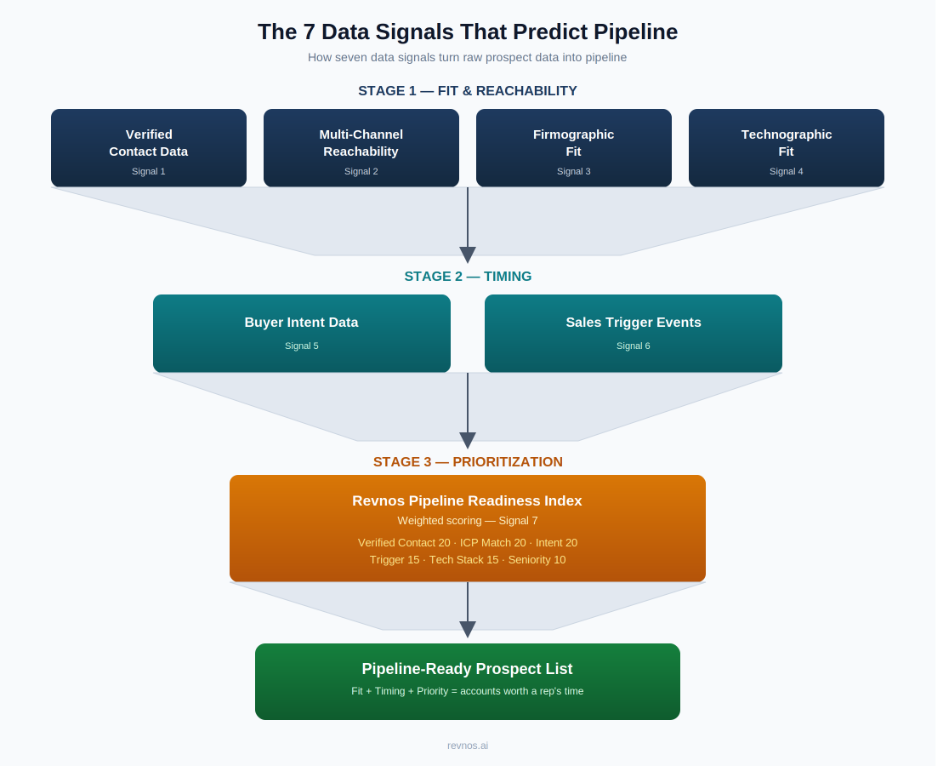
The seven data signals that predict pipeline don’t work in isolation.
They build on one another in three stages: first establishing fit, then identifying buying timing, and finally prioritizing accounts for outreach. The framework below shows how these signals combine to build a pipeline-ready B2B prospect list.
Signal 1: Verified Contact Data & Email Accuracy
Everything starts here. If the contact data is wrong, nothing else matters. Perfect ICP fit won’t help. Strong intent signals won’t help. Urgent trigger events won’t help either.
Why It Matters
Accurate contact data isn’t a nice-to-have. It’s the difference between a sequence that lands and one that bounces.
Email deliverability drives outbound success. High bounce rates waste more than a single send. They damage your domain reputation. That damage suppresses deliverability for every future campaign. A list with a 20% bounce rate isn’t 80% effective. It can sabotage an entire quarter of email outreach.
What “Accurate” Actually Means
Contact accuracy goes beyond checking if an email is real. It includes several factors:
- Verified emails — checked in real time, not just pattern-matched
- Current job titles — someone promoted months ago shouldn’t be prospected under an old title
- Direct dials, not switchboard numbers — a general company line rarely reaches decision-makers
- Active employment status — flags contacts who have already left the company
How to Apply It
A database of verified B2B contacts, refreshed continuously, is the baseline on which every other signal depends.
Verify every list before it enters a sequence. Segment contacts by confidence level. Send verified contacts into high-touch sequences. Give risky or catch-all contacts a lighter touch or manual check first.
Signal 2: Direct Dials & Multi-Channel Reachability
Email accuracy solves half the reachability problem. The other half asks whether you can reach a prospect at all.
Why It Matters
Modern buyers don’t live in one channel. Some decision-makers answer calls faster than emails. Others screen calls entirely. They engage only through LinkedIn or email. A list with only an email address locks reps into one saturated channel. Outbound prospecting works best when reps can move across channels without missing a beat.
What Good Reachability Data Includes
- Direct-dial phone numbers, not general office lines
- Mobile numbers, where available and compliant
- Verified LinkedIn profile URLs for social selling
- Time zone and location data for smarter call timing
How to Apply It
Build sequences that alternate channels on purpose. Email on day one. LinkedIn on day three. A direct-dial call on day five. Multi-channel cadences outperform single-channel ones consistently. They meet buyers where attention actually lives.
AI prospecting tools add real leverage here. Reps don’t hunt for a mobile number or LinkedIn URL manually. The data arrives pre-attached to each record.
Signal 3: Firmographic Fit
Firmographic data answers a simple question. Does this company look like your existing customers?
Why It Matters
Firmographic fit forms the backbone of ICP targeting. Without it, prospecting becomes spraying. You send the same message to companies of every size and industry. Firmographic filtering turns a list of “possible” buyers into “probable” buyers.
Key Firmographic Data Points
- Industry / vertical — does the company operate where your product has proven fit
- Company size/headcount — too small means no budget; too large may mean a mismatched sales cycle
- Revenue range — signals budget availability and deal size potential
- Geography — affects compliance, time zone, and localization needs
- Growth stage — a startup and an enterprise buy very differently
- Organizational structure — does the company have a function that owns this buying decision
How to Apply It
Treat firmographic fit as a hard filter, not just a scoring input. If a company falls well outside your proven ICP, don’t let intent or urgency override that. It’s still the wrong account.
Signal 4: Technographic Fit
Technographic data reveals what tools a company already uses. It’s one of the most underused signals in B2B prospecting. Firmographic and technographic data for sales teams work best layered together, not used separately.
Why It Matters
A company’s tech stack tells you two things. First, whether your product fits or replaces something they already use. Second, how technically sophisticated the buying team likely is. A modern, cloud-native stack behaves differently from a legacy, on-premise one.
Practical Technographic Use Cases
- Competitive displacement — accounts using a competitor’s product already understand the category
- Complementary tech signals — accounts using integrable tools often onboard faster and stick longer
- Tech maturity as a proxy — teams with modern infrastructure adopt new sales tools faster
- Gaps in the stack — a strong marketing stack with no sales intelligence tool signals a clear opportunity
How to Apply It
Layer technographic filters on top of firmographic ones. An account matching both your size criteria and your best customers’ tech stack beats one matching size alone.
Signal 5: Buyer Intent Data
Firmographic and technographic data answer “Does this account fit?” Intent data answers a more urgent question. Is this account in the market right now?
Why It Matters
This may be the single highest-leverage signal on this list. It directly addresses timing. Timing determines whether outreach feels helpful or feels like noise. A well-fitting account with no active research shows slow conversion. A well-fitting account that’s actively evaluating responds far more often.
What Buyer Intent Data Looks Like
- Content consumption signals — employees researching topics tied to your category
- Website engagement — target-account visitors browsing pricing or comparison pages
- Search behavior — surges in searches for relevant keywords or competitors
- Review site activity — engagement with product review platforms in your category
- Job postings — hiring for roles that hint at a new initiative
How to Apply It
Use intent data as a re-ranking layer, not a starting filter. First, build your ICP-matched list using firmographic and technographic data. The surface, which accounts for the intent this week. Prioritize that subset first.
This is where buyer intent data turns a static database pull into a living system. The same 500 accounts get reordered weekly based on active signals, which is exactly how intent data improves prospecting: it replaces a one-time snapshot with a constantly refreshed priority order. The result is a high-intent B2B prospect list that reorders itself as buying signals shift.
Signal 6: Sales Trigger Events
Trigger events are one of the clearest buying signals for sales prospecting because they’re timestamped and verifiable. They create a window where outreach becomes unusually relevant.
Why It Matters
Timing changes everything in outbound. The same email to the same person can get ignored one week and welcomed the next. Trigger-based outreach works because it shows the rep did their homework. The reason for reaching out is specific and timely.
Common, High-Value Trigger Events
- Funding announcements — new funding often unlocks budget for tools and headcount
- Leadership changes — new VPs often re-evaluate vendors within their first 90 days
- Company expansion — new offices or markets often need scaled processes
- Mergers & acquisitions — often trigger tool consolidation
- Product launches — often require a scaled go-to-market motion
- Compliance deadlines — create urgency tied to a hard date
- Relevant job postings — double as both technographic and trigger data
How to Apply It
Use trigger events to justify the reason for the outreach itself. Skip generic openers like “I wanted to introduce our platform.” Instead, try: “Congratulations on the Series B — teams at this stage often scale outbound.” This single shift lifts reply rates on cold outreach.
Signal 7: Account & Lead Scoring/Prioritization
The first six signals generate rich data. This seventh signal turns that data into action.
Why It Matters
Without scoring, even a richly enriched list stays just a list. Reps default to working it in whatever order feels convenient. That order rarely matches actual conversion likelihood. Scoring converts a flat list into a ranked queue. Effort goes where it earns the highest return.
What a Strong Scoring Model Includes
- Weighted firmographic fit — how closely the account matches your ICP
- Technographic alignment — presence of competitive or complementary tools
- Intent signal strength — how recent and how strong the buying signals are
- Trigger event recency — last week’s funding round matters more than last year’s
- Engagement history — has the account opened emails or visited your site
- Contact-level seniority — is this an actual decision-maker, not just a warm body
How to Apply It
Keep scoring dynamic, not static. Update scores as new intent data and trigger events arrive. Reps should work from a continuously reordered list. This turns raw prospecting signals into real lead qualification criteria your team can use daily.
Each signal above answers one question about an account. Here’s the full framework side by side, before we move on to scoring:
| Signal | Answers | Stage |
| Verified Contacts (Signal 1) | Can we reach them? | Fit & Reachability |
| Direct Dials (Signal 2) | Can SDRs contact them? | Fit & Reachability |
| Firmographics (Signal 3) | Are they our ICP? | Fit & Reachability |
| Technographics (Signal 4) | Will our product fit? | Fit & Reachability |
| Intent (Signal 5) | Are they researching? | Timing |
| Trigger Events (Signal 6) | Why now? | Timing |
| Scoring (Signal 7) | Who first? | Prioritization |
Revnos.AI Pipeline Readiness Index
The seven signals above matter individually. But sales teams need one number, not seven separate judgment calls, to decide who to call first.
That’s what the Revnos.AI Pipeline Readiness Index does. It converts the seven signals into a single, weighted score out of 100.
| Signal | Weight |
| Verified Contact | 20 |
| ICP Match | 20 |
| Intent | 20 |
| Trigger | 15 |
| Technographic Fit | 15 |
| Seniority | 10 |
How to read the score:
- 80–100: high-fit, in-market, reachable now. Call today.
- 60–79: strong fit, weaker timing signal. Good for this week’s cadence.
- Below 60: needs more qualification before it earns rep time.
How to Build a High-Converting B2B Prospect List
Understanding all seven signals matters. Turning them into a repeatable workflow matters more.
That means turning GTM data into a process your whole team can repeat, not just a one-time list pull. Here’s a practical, step-by-step approach.
Step 1: Define Your ICP
Start narrow. Pull data from your best existing customers. Note their industry, size, revenue range, and tech stack. Use this as your baseline filter. Resist widening the net “just in case.” A tight, accurate ICP beats a broad, vague one.
Step 2: Pull a Qualified Account List
Use a sales intelligence platform. Filter your total addressable market down to ICP-matched accounts. This becomes your base universe of accounts worth pursuing.
Step 3: Layer in Intent and Trigger Data
Within that base universe, find accounts showing active intent or recent trigger events. This subset becomes your priority tier. Work these accounts first, not eventually.
Step 4: Verify Contact Data
Run every contact through email verification. Confirm direct-dial accuracy. Segment contacts by confidence tier. Reps then know which contacts to send at volume and which need extra care. This step answers the question most teams struggle with: how to prioritize prospect lists once they’ve already been built.
Step 5: Apply the Revnos.AI Pipeline Readiness Index
Use the Revnos.AI Pipeline Readiness Index (see above) to combine these signals into one weighted score. Sort your final list by that score, highest first. Don’t sort it alphabetically or by company name.
Step 6: Build Multi-Channel Sequences
Reference the trigger event or intent signal directly in your outreach. Alternate channels based on each contact’s reachability data. Mix email, LinkedIn, and direct-dial calls.
Step 7: Refresh Continuously
Intent signals and trigger events expire quickly. A quarterly refresh is already stale for this data layer. Build a weekly refresh cadence at a minimum for intent and trigger data.
This workflow is exactly what a unified sales intelligence platform supports. It replaces five or six disconnected tools with one integrated system.
How Revnos.AI Combines These Signals Into One Platform
Most teams understand what good data looks like. They fail because assembling all seven signals manually takes too long. That’s the specific problem Revnos.AI solves.
One Database Instead of Five Tools
Most teams stitch together a contact database, a verification tool, an intent provider, and a trigger tracker. Revnos.AI brings all of this into one searchable platform. Teams build a list once. All seven signals attach from the start.
Accuracy at the Contact Level
Verified emails and direct dials refresh continuously. This addresses Signal 1 and Signal 2 directly. A prospect list is only as useful as its reachability. Revnos.AI treats this as the non-negotiable baseline.
Precision Targeting
Teams filter the total account universe by size, industry, revenue, geography, and tech stack. This turns Signal 3 and Signal 4 into a few clicks. Manual research per account is no longer necessary. This level of company intelligence means reps stop guessing and start targeting with precision.
Built-In Intent and Trigger Signals
Reps don’t need to monitor news feeds or job boards manually. Revnos.AI surfaces buyer intent and trigger events directly against pipeline accounts. Reps learn who to target and when the timing is right.
AI-Assisted Prioritization
AI prospecting capabilities help surface which qualified accounts deserve attention first. This operationalizes Signal 7 without a separate scoring spreadsheet.
Built for the Full Outbound Motion
Revnos.AI supports sequencing and outreach beyond list-building. The same platform that identifies a high-fit account can launch a trigger-aware sequence to that account. This closes the gap between finding a prospect and reaching them at the right time.
GTM teams spend less time assembling scattered data. They spend more time working on a prioritized, accurate, signal-rich list. That’s the entire point of a prospecting database.
Common Mistakes Teams Make When Building B2B Prospect Lists
A few recurring mistakes quietly undermine list quality. Watching for these matters as much as knowing the seven signals.
Mistake 1: Treating List Size as Quality
A list of 10,000 loosely-matched contacts underperforms a list of 500 tightly-matched contacts. Volume without fit just creates noise faster.
Mistake 2: Skipping Verification to Save Time
Skipping email verification usually backfires. This is the fastest way to damage a prospect list’s data quality without realizing it.
High bounce rates damage a sender’s reputation. That damage suppresses deliverability across every future campaign, even to verified contacts.
Mistake 3: Ignoring Technographic Data
Many teams rely on firmographic filters alone. They skip one of the strongest signals for fit and competitive positioning. Most sales intelligence tools already surface this data. Teams just aren’t using it.
Mistake 4: Never Refreshing the List
Intent data and trigger events expire. A list built in January and worked through June misses months of new signals. New funding rounds and leadership hires go unnoticed.
Mistake 5: No Prioritization Layer
Handing reps a flat, unranked list sets unrealistic expectations. Without explicit scoring, reps default to convenience over conversion likelihood.
Mistake 6: Generic Messaging Despite Rich Data
Even a perfect list underperforms if outreach ignores the signal work behind it. If an account shows a funding trigger, reference it directly. Otherwise, the data collection changed nothing for the buyer.
The Bottom Line on High-Converting Prospect Lists
Great prospecting isn’t about finding more prospects. It’s about identifying the small percentage of accounts that have the right fit, the right timing, and the right reason to engage today. Every signal you add narrows the gap between activity and pipeline.
A B2B prospect list is never just a list. It compresses decisions about who deserves a sales team’s time. Every signal covered here answers a different part of that decision.
Skip contact accuracy, and perfectly timed outreach never reaches the inbox. Also, skip firmographic and technographic fit, and reps waste cycles on accounts that were never going to buy. Skip intent and trigger data, and even a well-fitting account gets outreach at the wrong moment. Skip scoring, and your best accounts get buried under alphabetical order.
Put all seven together, and a prospect list stops being a static export. It starts behaving like a live, self-prioritizing pipeline engine. It tells your sales team who to call, why now, and in what order.
That’s the anatomy of a list that actually converts. Instead of stitching together contact databases, intent providers, enrichment tools, and trigger trackers, Revnos.AI brings every signal into one workflow. Verified contact data, buyer intent, trigger events, and account prioritization come together in a single platform, so GTM teams spend less time assembling data and more time engaging the right buyers.
Explore Revnos.AI to see how it helps GTM teams build prospect lists that stay accurate, prioritized, and ready for outreach.
Book a live demoFrequently Asked Questions
A high-converting prospect list targets B2B accounts using verified contact data, firmographic and technographic fit, buyer intent signals, and trigger events. It differs from a broad, unfiltered export of names and titles. It prioritizes accounts most likely to enter the pipeline.
Seven signals predict pipeline together: verified contact data, direct-dial reachability, firmographic fit, technographic fit, buyer intent data, sales trigger events, and account scoring. No single signal works alone. Predictive power comes from combining fit data with timing data and reachability data.
Define your ICP using firmographic and technographic criteria first. Use a sales intelligence platform to pull matching accounts. Layer in intent and trigger data to find in-market accounts. Verify all contacts before outreach. Apply a scoring model to rank your final list. Build multi-channel sequences that reference relevant signals.
Intent data surfaces which ICP-matched accounts are actively researching solutions right now. Teams re-rank the same list weekly based on intent strength and recency. This focuses effort where buying activity is already underway.
Accuracy, precise fit, and timing drive conversion. Verified, reachable contacts matter. Genuine ICP match on firmographic and technographic dimensions matters. Outreach timed around active intent or a recent trigger event matters most of all.
Revnos.AI combines verified contact data, firmographic and technographic filters, buyer intent signals, and trigger events in one platform. Teams build a list once, with all seven signals already attached. They launch multi-channel, trigger-aware outreach from the same platform used to identify accounts.

by Kapil Khangaonkar
Published on: July 8, 2026 |
Share: