
Most B2B sales teams still build prospect lists based on static filters like company size, industry, or job title. But the highest-performing GTM teams don’t just target the right accounts. They target them at the right moment. That’s where B2B buying signals come in.
B2B buying signals are actions, behaviors, or events that suggest a company or person may be in the market to buy something. They can come from something a prospect does directly, like visiting your pricing page, or from something happening inside their business, like a new round of funding or a wave of relevant job postings. When you catch these signals at the right time, you stop guessing about who to call and start having conversations with people who are actually ready to talk.
That definition matters a lot right now, because the way B2B buying signals actually work has changed. Buyers do most of their research before they ever talk to a sales rep. By the time someone fills out your demo form, they have probably already looked at a handful of competitors, read reviews, and formed an opinion. So if you are waiting for inbound to tell you who is ready, you are usually late.
Buying signals flip that script. They let you reach out before the buyer has made up their mind, when you can still shape how they think about the problem.
B2B Buying Signals: Quick Reference
| Topic | Key Insight |
| What are buying signals? | Actions or events indicating a prospect may be entering a buying cycle. |
| Strongest behavioral signals | Pricing page visits, demo requests, repeated website engagement, and content downloads. |
| Strongest company signals | Funding announcements, executive hires, technology adoption, rapid hiring. |
| Best practice | Prioritize accounts showing multiple signals rather than relying on a single event. |
| Response time | Act within 24–48 hours for high-intent signals whenever possible. |
| AI’s role | AI combines multiple signals to prioritize the accounts most likely to convert. |
Key takeaway: The highest-converting opportunities rarely come from a single buying signal. The best GTM teams monitor multiple behavioral, firmographic, and intent signals, enabling them to identify in-market accounts earlier and prioritize outreach more effectively.
Why B2B Buying Signals Matter More Than Ever in 2026
For years, outbound has been built around the same idea: find companies that fit your ICP and reach out at scale. That approach is becoming less effective as response rates decline and buyers become more selective about who they engage with.
The challenge is that the ICP fit only tells you who could buy. It doesn’t tell you who is actively evaluating solutions, planning a change, or dealing with a problem your product solves.
Signal-based selling helps bridge that gap. Instead of treating every account in your target market the same way, focusing on companies showing signs of active interest, emerging needs, or buying intent helps you. The result is that your outreach lands at a better moment, the conversations go further, and your pipeline reflects real opportunities rather than just contacts you have touched.
For SDR teams especially, this shift changes the whole job. Your day is no longer about working through a static list. It is about monitoring GTM signals, prioritizing accounts that are lighting up, and reaching out with a message that speaks directly to what is happening in that company right now.
The buyer’s journey in B2B has also become longer and more complicated. Multiple stakeholders are involved in most purchasing decisions. Buyer behavior signals help you understand not just which company might be in the market, but which individuals within that company are engaged and which conversations are happening internally. That context makes every touchpoint more relevant and more likely to move things forward.
There is also a timing dimension that is easy to underestimate. Reaching out to the right company one week too late can mean the difference between winning a deal and being told a decision has already been made. Sales pipeline prediction starts with understanding which accounts are most likely to be ready at this moment, and that is exactly what buying signals tell you. Signals help you show up at the right time, not just to the right account.
According to 6sense’s 2025 Buyer Experience Report, buyers now complete 60% of their journey independently before engaging a seller, and the average B2B sales cycle shortened from 11 months in 2024 to 10 months in 2025, meaning buyers are moving faster and deciding earlier, which makes timing your outreach around signals even more critical.
The Difference Between Intent Data and Buying Signals
Intent data and buying signals are not the same thing, even though most people treat them that way. There is a real difference worth understanding.
Intent data is a specific type of signal. It refers to buyer intent data collected from third-party sources about what topics a person or company is researching online. Intent data providers track content consumption across publishing networks and tell you when a company is showing up in content about certain topics. If a company is reading a lot of articles about cloud security or sales automation, that shows up as buying intent data.
Buying signals are the broader category. Buyer intent signals are one kind of buying signal, but there are many others. A company posting a job for a VP of Sales is a buying signal. A company announcing a new round of funding is a buying signal. A prospect opening your email three times in one day is a buying signal.
The best GTM teams are not just using one signal in isolation. They are stacking signals. If a company shows topic intent AND just raised funding AND is hiring salespeople, that combination is far stronger than any single signal on its own.
One more distinction worth making is first-party versus third-party signals. First-party signals are behaviors that happen directly in your own tools. Someone opens your email, clicks a link, or visits your website. These signals are highly reliable because they involve direct interaction with your brand. Third-party signals, including buyer intent data from intent platforms, are behaviors that happen elsewhere on the internet and are surfaced by data providers. A good signal stack uses both types in combination.
The practical takeaway is this: intent data for lead generation is a powerful starting point, but it works best when layered on top of other sales intelligence signals rather than used on its own. Account intent data tells you a company is researching a topic. Combine that with a hiring signal or a funding announcement, and you have a much clearer picture of whether a real buying process is underway.
The Signal Tiers: What Each One Actually Predicts: B2B Buying Signals
Understanding which B2B buying signals predict pipeline is what separates teams that prioritize well from teams that treat every prospect the same. Not all signals are created equal. Some tell you a company might buy something someday. Others tell you they are probably buying something right now. Knowing the difference is the foundation of any good sales pipeline prediction model and helps you prioritize where to spend your energy.
Tier 1: High Intent Signals (Act Now)
These are the outbound sales triggers that indicate a buying process is likely already in motion or about to start. When you see these, the window to engage is short.
Pricing page visits. When a known contact or a tracked company visits your pricing page, that is about as clear a signal as you get. They are not doing research for fun. They are evaluating whether your solution fits their budget.
Direct demo requests or form fills. Someone has explicitly expressed interest. The question is how fast you follow up and how good the first conversation is.
Competitor content consumption. If someone from a target account is spending time on competitor review sites or reading comparison content, a buying decision is probably in motion. They are building their shortlist.
Multiple stakeholders engaging. If you see two or three people from the same company opening your emails or visiting your website around the same time, something is being discussed internally. This is a strong pipeline trigger that tells you to accelerate outreach immediately.
Direct product research intent. High-volume account intent data showing that a company is actively consuming content about your product category over a short period is a strong indicator of active evaluation.
Tier 2: Strong Contextual Signals (Move Quickly)
These B2B sales triggers do not confirm a purchase is imminent, but they indicate the conditions are right and the window is opening.
New round of funding. A company that just closed a Series A, Series B, or later-stage round is almost certainly going to spend money. Leadership is under pressure to grow. New tools and vendors are being evaluated. The budget exists, and the motivation to move fast is high.
New executive hire. When a new VP, CRO, CMO, or COO joins a company, they typically come in with their own agenda, their own preferred tools, and a mandate to make changes. The first 90 days of a new executive’s tenure are one of the most active buying windows in B2B.
Hiring signals in relevant roles. Job postings are underutilized sales prospecting signals. If a company is hiring a Head of RevOps, they are probably thinking about their tech stack. If they are hiring SDRs, they are probably about to invest in prospecting tools. The job posting tells you what the company is actively building, which tells you what they might need.
Technology changes. If a company installs or removes a key piece of technology, that is a moment of transition. Companies that have just moved to a new CRM are often in the market for adjacent tools. Companies that cancelled a contract with a competitor are actively looking for an alternative.
Company expansion into new markets or regions. When a company announces international expansion or opens offices in new territories, it creates buying needs across almost every functional area.
Tier 3: Directional Signals (Build the Relationship)
These signals don’t mean a company is buying now, but they show it’s worth watching and warming up.
Topic intent at low volume. A company consuming some content about your category is worth adding to a nurture sequence. They may not be ready yet, but they are thinking about the problem space.
Social engagement. A prospect who follows your company on LinkedIn or comments on your CEO’s post is showing awareness and interest. Not enough to call immediately, but enough to send a personalized connection request or a light-touch message.
Content downloads and newsletter subscriptions. These show interest in the topic, even if the prospect is not actively evaluating yet. Good enough to move someone into a nurture flow and watch for higher-intent signals.
The B2B Buying Signal Tiering Table
| Signal | What It Predicts | Typical Impact | Action Window |
| Pricing page visit from a known contact | Active evaluation in progress | Very High — 4x conversion lift vs cold outreach | Same day |
| Demo request or form fill | The buyer has raised their hand | Very High | Within hours |
| Multi-stakeholder engagement from same account | An internal buying conversation is happening | Very High | Same day |
| Competitor review site activity | Shortlist is being built | High | Within 48 hours |
| New funding announced | Budget available, vendor evaluation likely | High — peak window is 14 to 30 days post-announcement | Within 48 hours |
| Technology installation or removal | Stack transition underway | High | Within 48 hours |
| New executive hire (CRO, VP Sales, CMO) | New vendor selections coming | High — evaluation window opens immediately, closes within 7 days | Within 1 week |
| Hiring signals in relevant roles | Stack evaluation likely | Medium to High | Within 1 week |
| High volume topic intent | Active research into your category | Medium | Within 1 week |
| Company expansion or new market entry | A new vendor needs to be opened up | Medium | Within 1 week |
| Low volume topic intent | Early awareness, not yet in market | Low | Nurture sequence |
| Social engagement or content download | Interest exists, readiness unclear | Low | Nurture sequence |
How to Identify Buying Signals in B2B Sales
Before you can act on buying signals, you need a system for spotting them. This is where a lot of teams fall short. Knowing how to identify buying signals in B2B sales at scale requires more than understanding what signals are in theory. It requires a consistent process for surfacing them across your full account list.
The starting point is knowing what you are looking for. Go back to your closed-won deals from the past year and look for patterns. What was happening at those accounts in the 30 to 60 days before they entered your pipeline? Were they hiring certain types of roles? Had they recently raised funding? Were multiple people from the same account engaging with your content? Those patterns are your signal fingerprint, and they tell you which triggers to monitor going forward.
The next step is making sure you have the right tools and watching for those triggers. Manual monitoring does not scale. You need sales intelligence that tracks company events, hiring activity, technology changes, and buyer intent data automatically across your entire target account list. When a signal fires, it should surface in your workflow immediately, not require you to go looking for it.
Trigger-based outreach is the natural output of this process. Every time a relevant signal fires for an account in your ICP, a pre-built outreach sequence activates. The rep reviews it, personalizes the first touch with the specific signal context, and sends it. That is the loop: signal fires, outreach activates, rep personalizes and sends. The faster and more consistently the loop runs, the more pipeline you generate from the same account list.
How GTM Teams Are Actually Using B2B Buying Signals in 2026
Understanding signals in theory is one thing. Building a motion around them is another. Here is what the teams doing this well actually look like.
- They Have a Signal Stack, Not a Single Source
The best GTM teams never rely on a single signal source. They pull data from multiple places: their own CRM engagement data, third-party buyer intent tools, company news feeds, hiring data, and technology install data. All of that gets layered together at the account level to build a fuller picture of what’s occurring inside a target company.
The logic is simple. One weak signal might mean nothing. Two or three signals firing at the same time from the same account almost always mean something real is in motion. That combination is what generates confidence in a prospect, not any individual data point in isolation.
This is what account-based selling signals look like in practice: multi-source, contextual, and anchored to account-level activity rather than the behavior of a single person.
- They Use ABM Intent Data to Coordinate Sales and Marketing
For teams running account-based selling, ABM intent data is particularly powerful. When your marketing team and your sales team are both looking at the same account intent data, they can coordinate their outreach so that a target account gets touched from multiple directions at exactly the right moment.
Marketing runs targeted ads to the buying committee at a company that is showing high intent. Sales reaches out directly to the economic buyer with a personalized message. The combination of paid visibility and direct outreach creates a surround-sound effect that is much harder to ignore than either motion on its own.
Modern account-based selling signals are coordinated, timely, and rooted in real buyer behavior data, not assumptions or guesswork at all.
- They Assign Signals to Sequences, Not Just to Reps
A common mistake is to surface signals to reps and then leave it to each rep to decide what to do with them. The better approach is to build pre-written sequences for each major signal type, so that when a signal fires, there is already a ready-made playbook.
The new funding sequence looks different from the new executive sequence, which looks different from the competitor intent sequence. Each one speaks to what is actually happening at that company right now.
- They Track Signal Decay
Signals have a shelf life. Funding news that is six months old is not a strong signal anymore. A job posting that has been up for four months may already be filled. New executive hires are most receptive in their first 60 to 90 days.
Good GTM teams track when a signal fires and make sure outreach happens within the right window. If the signal is missed, they deprioritize that account rather than reaching out to stale.
What Are the Strongest Sales Triggers for Outbound Prospecting?
When it comes to outbound specifically, not all B2B outbound sales triggers are equal. Outbound prospecting is a different game from inbound follow-up. You are reaching out to people who have not asked to hear from you, so the signal you are acting on needs to give you a genuinely good reason to reach out and a relevant thing to say.
Here are the sales triggers that consistently work best for outbound prospecting.
- New executive hire. This is arguably the single strongest outbound sales trigger. A new VP or C-suite hire is actively making decisions, evaluating vendors, and is open to conversations. They do not have existing relationships with your competitors yet. They want to prove impact fast. Reaching out in their first 30 to 60 days with a message that speaks to their priorities is one of the highest-converting outbound moves you can make.
- Funding announcement. Publicly available, time-sensitive, and directly connected to the budget. A funding announcement gives you a natural reason to reach out and a clear narrative: they are growing, growth creates problems, your product helps solve those problems.
- Relevant job posting. A job posting tells you what a company is building at this moment. If that aligns with what you sell, it is a strong outbound trigger. Your message can reference what they are building and position your product as something that helps them get there faster.
- Technology removal or competitor churn. If you know a company has stopped using a product that competes with yours, they are almost certainly shopping. This is one of the most valuable outbound sales triggers available and often one of the most underused because the data is harder to come by.
- High-volume buyer intent signals. When account intent data shows a company is consuming a lot of content about your product category right now, that is a green light for outbound. They are already thinking about the problem. Your job is to show up as the right solution.
The common thread across all of these is that they give your outreach a reason to exist beyond “we have a product you might like.” Trigger-based outreach that references something specific and real about what is happening at the prospect’s company converts at a meaningfully higher rate than generic cold outreach.
Are Hiring Signals Actually Good Indicators of Buying Intent?
Yes, but it depends on the role and how you read the signal.
Hiring signals are not direct buying signals in the way that a pricing page visit is. Someone posting a job does not mean they are definitely about to buy your product. But the correlation between specific types of hires and near-term purchasing is real and well-established among experienced GTM teams.
When a company hires for a specific function, they are announcing a strategic priority. The job posting tells you what problem they are trying to solve, what skills they value, and often what buyer intent tools or platforms they expect candidates to know.
Firstly, a company hiring a Director of Demand Generation is almost certainly going to evaluate marketing technology. Also, a company hiring a Sales Operations Manager is probably thinking about their CRM and sales tools, and a company hiring a Head of Customer Success may be looking at CS platforms or expansion revenue tools.
The key is to match the hiring signal to your specific product and to reach out with a message that shows you understand what they are building. Generic outreach on the back of a hiring signal gets ignored. Specific, relevant outreach that connects the role they are hiring to the problem your product solves can be genuinely impressive to a buyer.
Also, do not just look at the title. Read the job description. The skills required, the tools mentioned, and the KPIs described in the posting can give you much better material for a personalized message than just knowing they are hiring a “Sales Manager.”
How Does Funding Signal B2B Purchase Intent?
Funding announcements are among the most reliable B2B sales triggers available, and they are public information that anyone can act on.
When a company raises money, especially at the Series A stage or beyond, they have just accepted pressure to grow. The investors who wrote that check expect results within a defined timeframe. The leadership team knows they have to move fast. That urgency translates directly into purchasing decisions.
Teams get hired. New sales reps need tools; marketers need platforms. Also, new engineers need infrastructure. The tech stack that worked for a team of 20 may not work for a team of 50, and there is usually a budget allocated specifically to upgrade it.
The window matters here. The first few weeks after a funding announcement are the hottest. Leadership is in planning mode, the team is excited, and budgets are being allocated. If you reach out within days of the announcement with a relevant, specific message, you are entering the conversation at exactly the right moment.
According to Lusha’s Q2 2026 Buying Signal Report, the 14 to 30-day window after a funding announcement is when vendor conversations are most actively welcomed, because the capital deployment plan is still being built and vendor selections are happening inside that planning process.
Understanding the funding stage also helps you tailor the message. A Series A company starting to build its first sales team has very different needs from a Series C company expanding internationally. The signal is strong in both cases, but the context makes your outreach far more relevant.
What Buying Signals Should SDRs Prioritize First?
If you are an SDR trying to figure out where to spend your energy on a given day, here is a simple prioritization framework built around buying signals for SDR teams.
First, work the explicit inbound signals. Demo requests, pricing page visits from known contacts, and any direct engagement from someone in a target account. These people have done something that shows intent. They deserve a fast, thoughtful follow-up.
Second, work the account-level combination signals. Any account where multiple signals are firing at the same time deserves immediate attention. Funding, plus a new executive hire, plus high-volume buyer intent signals, is an extremely hot account.
Third, work the single high-tier signals. Funding announcements, new executive hires, and technology changes from accounts that fit your ICP well. Worth acting on within a few days.
Fourth, build and monitor the lower-tier signals. Add accounts showing early intent or light engagement to watch lists and nurture sequences. Check in on them regularly and look for escalation into higher-tier signals.
The trap that many SDRs fall into is spending too much time on the lowest-tier signals because there are more of them. Tier 1 and Tier 2 signals convert into conversations at a much higher rate than Tier 3, even if Tier 3 signals are more abundant.
How AI Is Changing the Way Teams Identify Sales-Ready Accounts
Manual signal tracking used to be a real operational challenge. Someone had to monitor funding news, track job postings, pull buyer intent data, and correlate all of that with CRM records. Even with good tools, it was time-consuming and incomplete.
AI sales intelligence changes this in a meaningful way. Modern AI-powered sales intelligence platforms can monitor thousands of signals across an entire target account list simultaneously, surface the most relevant ones in real time, and prioritize accounts based on how many signals are firing and how strong they are.
What this means practically is that a well-configured AI sales intelligence platform can tell an SDR each morning which accounts are the highest priority that day and why. The rep does not have to manually piece together the context. They just have to act on the intelligence they are given.
AI also helps with signal interpretation. A job posting for “Revenue Operations Manager” might sound generic, but an AI that knows your ICP and product can recognize that this specific posting at this specific company size and vertical is a strong buying signal for your solution.
Beyond signal detection, AI is also being used to generate the first draft of personalized trigger-based outreach based on the signals it has found. A platform can see that a company just raised a Series B, is hiring a RevOps lead, and has been consuming content about sales automation, then generate an email that references all of those things in a way that feels relevant and timely.
The teams that get the most out of AI sales intelligence are the ones that treat it as a tool that augments their judgment rather than replaces it. The AI tells you who to talk to and gives you the context to do it well. The rep still has to have a good conversation.
How to Track Buying Signals Without Losing Your Mind
One of the common problems GTM teams run into is that signal data starts coming from too many places: the CRM, the email tool, the intent platform, the job board tracker, and the news aggregator. Synthesizing all of that manually is genuinely hard.
The solution that works best is to consolidate signals into a single view at the account level. Your CRM or sales intelligence platform should show you, for any given account, all the signals that have fired recently and when they fired. Good sales intelligence does not just surface individual data points. It connects them to a picture of what’s occurring at an account right now.
From that unified view, you can run a daily review, surface the accounts with the most active signal clusters, and assign priority. Automated alerts that fire when a high-priority signal appears mean that reps do not have to log in and check manually. The signal comes to them, and they act on it immediately.
Buyer intent tools play an important role here, too. The best buyer intent tools do more than just show you which topics a company is researching. They integrate with your CRM and your sales engagement platform so that intent data flows directly into your workflow rather than sitting in a separate dashboard. When intent data is connected to your account records and your outreach sequences, it becomes actionable. When it sits in a separate tool that reps have to log into separately, it gets ignored.
The teams that struggle with signal-based selling are usually the ones that have the data but no system for acting on it. Building the habit and the process around signal review is just as important as having the right tools.
The Biggest Mistake GTM Teams Make With Buying Signals
Most teams overreact to a single signal and treat it as confirmation that an account is ready to buy. It rarely is. A funding announcement alone does not mean a company is evaluating your category. A job posting alone does not mean the budget is approved.
DemandScience’s December 2026 State of Performance Marketing Report, based on 750 senior B2B marketing leaders, found that 87% of organizations say their marketing investments produce signals that look like buying intent but do not reflect it, and only 26% of those signals convert into qualified opportunities. The signal quality problem is real and widespread.
The solution is not to abandon signals but to require multiple signals before elevating an account to active outreach. ABM Leadership Alliance and Demandbase 2026 data show that programs combining multiple account signals generate 2.6x more pipeline per marketing dollar than broad-reach demand generation, with 41% higher win rates. The difference between a signal program that generates a pipeline and one that generates noise is almost always the same thing: stacking signals, not reacting to individual ones.
How Revnos.AI Helps GTM Teams Detect and Act on B2B Buying Signals
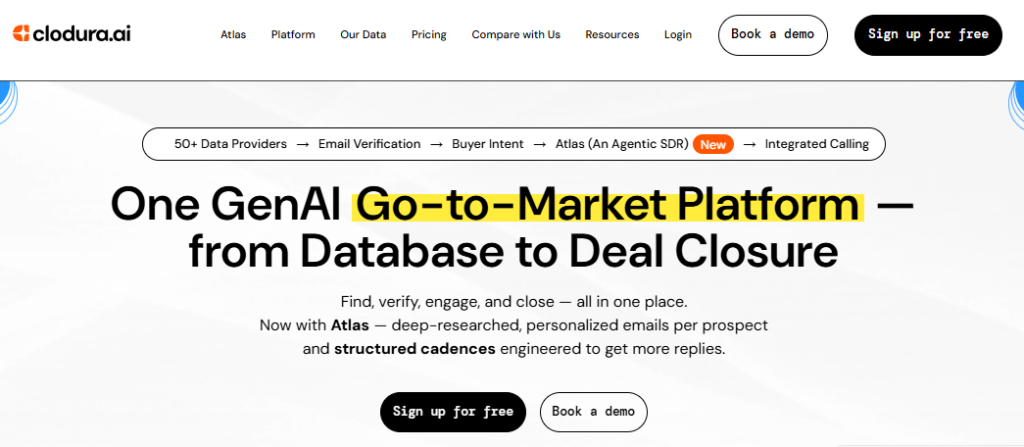
Revnos.AI helps GTM teams identify sales-ready accounts using verified B2B data, intent signals, company insights, and AI-powered prospecting workflows so SDRs can act when buyers are most likely to engage. The platform brings signal intelligence and prospecting data together in one place, moving teams from static prospect lists to signal-based selling.
- Buyer intent signals. Revnos.AI surfaces buyer intent data at the account level so you can see which of your target companies are actively researching topics related to your product. You can filter your prospect list by intent, so you are looking at accounts showing up in buying intent data right now, not just everyone in your territory.
- Hiring signals. The platform tracks job openings across companies and surfaces them as sales intelligence signals. You can filter prospecting by job opening type, so you are finding companies that fit your profile and are actively building in a way that suggests they need what you sell.
- Company triggers. Revnos.AI also surfaces pipeline triggers like funding announcements and other business events that indicate a window of opportunity. These triggers show up alongside contact and company data, so you can immediately see who to reach out to when a relevant event fires.
- ABM intent data. For teams running account-based selling, Revnos.AI makes it easy to align sales and marketing around the same account-based selling signals. Marketing can see which accounts are showing the highest intent and prioritize them for paid campaigns. Sales can use the same data to time their outreach. That coordination is what makes ABM actually work.
- Verified contact data at the moment of the signal. When a signal fires, you can act immediately without switching tools to find contact information. Revnos.AI combines signal detection with verified contact data so the loop from signal to outreach is as short as possible.
- Sales engagement built in. You can move from signal to contact to sequence without leaving the product. Less friction means faster trigger-based outreach, which matters a lot when signal windows are short.
- AI-powered prospecting with Atlas. Revnos’s Atlas is an agentic SDR powered by AI sales intelligence that can interpret signals and turn them into personalized outreach at scale. Instead of a rep having to manually research each account and write each email, Atlas takes the signal context and generates a personalized first touch that speaks to what is actually happening at that company.
You can explore plans at Revnos.AI and see which of your target accounts are signaling right now.
Building Your Own Signal-Based Selling Motion
Knowing how to use B2B buying signals for outbound sales is one thing; building a repeatable motion around them is another. If you want to move from theory to execution, here is a practical path for getting started.
Step one: Define your ICP tightly. B2B buying signals are only useful if you are watching the right companies. Make sure you have a clear definition of what an ideal customer looks like in terms of company size, industry, geography, and technology profile before you worry about signals.
Step two: Choose your top three to five signals. Start with the ones that are most predictive for your specific product. If new executive hires are consistently associated with closed deals in your history, that is a top signal. Let your own data guide you.
Step three: Set up monitoring with the right buyer intent tools. Use a platform that surfaces these signals automatically and configure alerts so that your top signals trigger immediate notifications. The right buyer intent tools will integrate with your CRM so that account intent data flows into your existing workflow without creating a separate place to check.
Step four: Build signal-specific sequences. Write outreach templates for each major signal type. The message for a funding signal should acknowledge the news and connect it to a growth challenge your product helps with. The message for a new executive hire should speak to what that person is likely thinking about in their first 60 to 90 days.
Step five: Define your response timelines. Decide how fast you will act on each signal tier and build those timelines into your team’s daily rhythm, so signals do not go stale.
Step six: Measure and iterate. Track which signals are converting into conversations and the pipeline. Let the data tell you where to focus more energy over time.
The Bottom Line: B2B buying signals
B2B buying signals are not a new concept, but the ability to act on them systematically and at scale is genuinely newer. The teams building signal-based selling motions right now have a real competitive advantage over teams still working from static lists.
The sales triggers that predict pipeline most reliably are the ones that show active evaluation or organizational change: direct engagement with your brand, new executive hires, funding announcements, and multi-signal account clusters. Acting fast matters as much as acting smart, because signal windows close and competitors are watching the same data.
If you are not yet tracking signals systematically, start simple. Pick your top three signal types, set up monitoring with the right buyer intent tools, build sequences for each trigger, and define how fast your team will act when a signal fires. That basic motion, done consistently, will outperform spray-and-pray outbound every single time.
And if you want a platform that brings AI sales intelligence, ABM intent data, and B2B prospecting together without stitching five different tools together, Revnos.AI is worth exploring. You can start for free and see what your target accounts are signaling at this moment.
Ready to build a signal-based selling motion? Book a demo with Revnos.AI today and see how buyer intent signals, hiring signals, and verified contact data work together in one place.
Book a DemoFrequently Asked Questions
The strongest buying signals are the ones that indicate active evaluation or decision-making is already underway. Direct engagement with your pricing page or demo request forms is the clearest because they come from the buyer themselves. After that, new executive hires, funding announcements, and multi-stakeholder engagement from the same account are consistently among the strongest signals that GTM teams act on.
No single signal reliably predicts a closed deal, but combinations of signals are much more predictive. Accounts where you see multi-stakeholder engagement, active buyer intent signals on your product category, and a company event like funding or a new executive hire tend to be the accounts that convert at the highest rate. Engaging quickly before competitors do also significantly improves your chances.
The most practical approach is to use a sales intelligence platform that aggregates multiple types of signals in one place, including buyer intent data, hiring signals, and company events. Supplement this with CRM engagement tracking for first-party signals. The key is to have automated alerts and a daily review process so that signals get acted on within the right window rather than sitting in a dashboard no one checks.
Yes, with context. Hiring signals are strong sales prospecting signals when the role being hired aligns closely with your product category. They are less useful in isolation and more powerful when combined with other signals. Reading the full job description rather than just the title gives you much better material for a personalized outreach message.
Most teams build a tiering model where accounts get prioritized based on the number and strength of signals they are showing. Accounts with multiple high-tier signals get elevated to immediate outreach. Accounts with single-directional signals get added to nurture sequences. The daily rep workflow centers on working accounts in priority order based on current signal activity rather than static lists.

by Kapil Khangaonkar
Published on: June 26, 2026 |
Share: