
If you are looking for the Best Clay Competitors and Alternatives in 2026, the strongest all-in-one option for most go-to-market teams is Revnos.AI, It pairs a 600M+ owned B2B database with built-in intent data, email verification, and outreach cadences at a flat $99/month, so you get both the data and the execution layer in one predictable platform.
Clay is a brilliant workflow engine, but it orchestrates third-party data on a credit-based model and stops short of actually running your outreach, which is exactly where many teams start hunting for an alternative.
Clay’s March 2026 pricing overhaul (Launch at $185/month, Growth at $495/month, plus a new dual-credit system) only sharpened the question for budget-conscious teams: is a credit-metered enrichment tool the right center of gravity for your GTM motion, or do you need a platform that owns its data and executes campaigns end to end?
To help you decide, we compared the top 8 Clay competitors and alternatives in 2026 across pricing, data model, features, and execution, so you can match the right go-to-market platform to your team’s size, budget, and motion.
Key Takeaways
- Best overall Clay alternative: Revnos.AI, an all-in-one GTM platform with a 600M+ owned database, buyer intent, and built-in outreach at a flat $99/month.
- Why teams leave Clay: unpredictable credit-based costs, no proprietary database, a steep learning curve, and no built-in way to send outreach.
- Best by use case: Apollo.io (prospecting + outreach), ZoomInfo (enterprise data depth), Cognism (compliant EU data), Smartlead (deliverability), Common Room and Warmly (buying signals), and Unify (warm-outbound automation).
- The deciding factor: the pricing model matters more than the sticker price. Flat-rate platforms remove the budget surprises that credit-metered tools create.
What Is Clay?
Clay is a data enrichment and workflow automation platform that lets go-to-market teams build no-code workflows to find, research, and personalize outreach to prospects. It sits between your raw data sources (LinkedIn, your CRM, spreadsheets) and your outreach tools.
Its standout strength is the “waterfall” model: Clay connects to 150+ third-party data providers and cascades through them to maximize match rates, then layers on AI research via its agent, Claygent. For technical GTM engineers who want granular control, this is genuinely powerful. The trade-off is that Clay does not own a proprietary database, charges credits per enrichment action (even on failed lookups under the legacy model), and does not natively send your emails; you still export to a separate sequencing tool to actually execute.
What Is a GTM Platform?
A GTM (go-to-market) platform is software that helps sales, marketing, and RevOps teams find the right accounts, enrich them with accurate data, detect buying signals, and run coordinated outreach to convert them into a pipeline. GTM stands for “go-to-market”, the strategy and systems a company uses to take a product to its target customers.
The best go-to-market platforms in 2026 unify four jobs that teams used to stitch together from separate vendors: a contact and company database, buyer-intent signals, data enrichment, and multi-channel engagement. Consolidating these reduces vendor sprawl, cuts cost, and removes the integration glue (Zapier, n8n, manual CSVs) that slows GTM teams down.
Why GTM Teams Look for Clay Competitors and Alternatives in 2026
Clay is a capable platform, but several recurring frustrations push teams to evaluate competitors:
- Unpredictable credit costs. Clay’s pricing is metered by credits, and real-world spend scales fast. Growing teams frequently report $800–$4,000/month once enrichment volume and AI steps ramp up. Credits, not seats, are what wreck budgets.
- You pay for failed lookups. Under Clay’s legacy model, every provider queried in a waterfall consumed credits even when it returned nothing. If three providers came back empty, you still paid for three. The March 2026 overhaul improved this, but enrichment-heavy lists remain hard to forecast.
- No proprietary database. Clay orchestrates external providers rather than owning its data. That means your match rates, accuracy, and cost-per-lead depend on which third-party sources you stack, and on how well you build the waterfall.
- Steep learning curve. Users routinely say it took weeks to understand Clay’s full capabilities. The flexibility that GTM engineers love is the same complexity that slows down a typical SDR who just needs a verified direct dial.
- No built-in execution layer. Clay preps the data; it does not run your sequences. You still need a separate outreach tool to send, follow up, and track replies, adding another subscription and another integration to maintain.
- A 2026 price increase. Clay’s restructuring replaced the older Starter ($149), Explorer ($349), and Pro ($800) tiers with Launch ($185) and Growth ($495). For many small teams, the new entry point is meaningfully higher than where they started.
The takeaway: Clay is a specialist. If your team would rather have data, intent, and outreach in one predictable, easy-to-use platform, the Clay competitors & alternatives below approach the problem differently.
How We Selected These 8 Clay Competitors and Alternatives
We evaluated more than 20 go-to-market and sales intelligence platforms and shortlisted the top 8 by weighing the factors that matter most when replacing Clay: data ownership and accuracy, pricing transparency and predictability, intent and signal capabilities, built-in execution, ease of use, and CRM integration.
We cross-referenced verified user reviews on trusted platforms like G2 and Capterra alongside hands-on research, and deliberately chose tools that cover the distinct jobs Clay touches, from owned-database all-in-one platforms to signal intelligence and outbound execution, so there’s a genuine fit for every GTM motion.
Top 8 Clay Competitors and Alternatives: Quick Comparison
| GTM Platform | Best Suited For | Key Highlights | Pricing (approx.) |
| Revnos.AI | Teams wanting data + intent + outreach in one predictable platform | 600M+ owned contacts, 250M+ verified emails, 18M+ org charts, buyer intent, built-in cadences, free email verification | Free Forever; Max $99/mo; PAYG $99 (billed once) |
| Apollo.io | SMBs wanting prospecting + outreach in one tool | Large contact database, sequences, AI writer, Chrome extension | Free; paid from ~$49/user/mo |
| ZoomInfo | Enterprises needing maximum data depth | Deep firmographics, intent, GTM Copilot, broad integrations | Custom (commonly $15k+/yr) |
| Cognism | EU/global teams needing compliant, phone-verified data | GDPR-compliant database, Diamond-verified mobiles, intent | Custom |
| Smartlead | Teams scaling cold outreach + deliverability | Unlimited mailboxes, warmup, inbox rotation, reply management | From ~$39/mo |
| Common Room | RevOps wanting signal-based GTM intelligence | Captures person-level signals across channels, automations, routing | Free plan; paid custom |
| Warmly | Inbound teams converting warm website traffic | Website visitor de-anonymization, real-time intent, orchestration | Free; paid from ~$700/mo |
| Unify | Teams wanting agentic warm-outbound automation | Intent signals + AI agents + automated sequences in one flow | Custom |
This quick comparison shows that each Clay Competitors and Alternatives is built for a different GTM use case.
Revnos.AI: Best for teams that want verified B2B data, buyer intent, email verification, and outreach automation in one predictable GTM platform.
Apollo.io: Best for SMBs that need a combined prospecting and outreach tool with a large contact database, sequences, and AI writing support.
ZoomInfo: Best for enterprise teams that need deep company data, firmographics, intent signals, and advanced GTM intelligence.
Cognism: Best for EU and global sales teams that need GDPR-compliant data, phone-verified contacts, and reliable mobile numbers.
Smartlead: Best for teams focused on scaling cold email outreach with unlimited mailboxes, warmup, inbox rotation, and deliverability tools.
Common Room: Best for RevOps and GTM teams that want to capture buyer signals from communities, product activity, and digital channels.
Warmly: Best for inbound sales teams that want to identify anonymous website visitors and convert warm traffic into pipeline.
Unify: Best for teams that want AI-powered warm outbound automation using intent signals, AI agents, and automated sequences.
Before that, let’s compare the pricing of all these 8 Clay Competitors and Alternatives…
Clay Pricing vs Alternatives: Full Cost-by-Cost Comparison (2026)
The single biggest reason teams leave Clay is cost predictability, not cost itself. Clay’s credit-based model means two teams on the same plan can pay wildly different amounts depending on enrichment volume, so the sticker price rarely matches the invoice. Here’s how the 8 Clay Competitors and Alternatives compare on entry price, pricing model, and free access.
| Platform | Entry price | Pricing model | Free tier | Predictable bill? |
| Revnos.AI | $99/mo (flat) | Flat subscription | Free Forever | ✅ Yes |
| Clay | $185/mo (Launch) | Credit-based (Data Credits + Actions) | Free (limited credits) | ❌ Scales with usage |
| Apollo.io | ~$49/user/mo | Per-seat | Yes | ⚠️ Per-seat + credits |
| ZoomInfo | ~$15k+/yr | Custom annual | No | ⚠️ Custom |
| Cognism | Custom | Custom annual | No | ⚠️ Custom |
| Smartlead | $39/mo | Flat (by volume tier) | Trial | ✅ Mostly |
| Common Room | Custom (free plan) | Contact-based | Yes | ❌ Scales with contacts |
| Warmly | ~$700/mo | Usage / visitor-based | Yes (500 visitors/mo) | ❌ Scales with traffic |
| Unify | ~$700/mo | Credit-based | No | ❌ Scales with usage |
The takeaway on cost: credit- and usage-based tools (Clay, Common Room, Warmly, Unify) start cheap but get unpredictable as you scale, which is exactly the budgeting problem teams cite when leaving Clay. Flat-rate platforms like Revnos.AI trade that uncertainty for one predictable number, and bundle the data, intent, and outreach you’d otherwise pay three vendors for. If you’re replacing Clay primarily to control spend, the pricing model matters more than the entry price.
A Detailed Look at the Top 8 Clay Competitors and Alternatives
1. Revnos.AI — Best All-in-One GTM Clay Alternative

About Revnos.AI
Revnos.AI is an AI-powered B2B sales intelligence and GTM platform that does what Clay deliberately does not: it owns its data and executes your outreach. Instead of orchestrating 150+ third-party providers and metering you by credit, Revnos.AI gives you direct access to its proprietary database of 600M+ contacts, 250M+ verified emails, and org charts for 18M+ companies, plus AI-powered buyer intent, built-in sales cadences, and email verification all under one flat, predictable subscription.
That combination makes Revnos.AI the most complete Clay Competitor for teams that want fewer tools, more accurate data, and a clear path from “find the account” to “land the meeting” without exporting to a separate sequencer.
Revnos.AI vs Clay: Head-to-Head
| Highlights | Revnos.AI | Clay |
| Starting price | $99/month (Free Forever plan available) | Launch $185/mo, Growth $495/mo |
| Pricing model | Flat & predictable | Credit-based (Data Credits + Actions) |
| Proprietary database | ✅ 600M+ owned contacts | ❌ Orchestrates 150+ third-party providers |
| Verified emails | 250M+ | Sourced via providers |
| Data accuracy | 95% | Varies by provider/waterfall |
| Built-in outreach & cadences | ✅ | ❌ (export to another tool) |
| Buyer intent data | ✅ | Via integrations |
| Free email verification | ✅ | Via providers |
| Org charts & install-base data | ✅ | ❌ |
| Learning curve | Low | Steep (weeks, per users) |
| Best for | Data + execution in one platform | Custom enrichment workflows |
Key Features of Revnos.AI
- 5 capabilities, 1 platform: Database, sales engagement, email verification, buyer intent, and data enrichment in a single tool, designed to replace several point solutions at once.
- Buyer intent data: AI-powered intent tracking with 25+ customizable triggers (funding, hiring, tech adoption, partnerships) so you reach accounts when they are most likely to buy.
- Built-in sales cadences: Automate multi-step email sequences and follow-ups natively, then sync everything to your CRM.
- CRM integration: Connects with Salesforce, HubSpot, Pipedrive, Zoho, Freshsales, and Microsoft Dynamics 365.
- Free email verification tool: A built-in free email verifier tool to validate lists in real time to cut bounce rates and protect sender reputation.
Revnos.AI Pricing
| Free Forever | Max | PAYG | |
| Yearly | $0 | $89/mo | $99 |
| Monthly | $0 | $99/mo | Billed once |
Transparent, flat pricing with a genuine free-forever plan, no credit math, no failed-lookup charges, and no separate outreach subscription to bolt on.
Revnos.AI Compared With Clay
Where Clay gives technical GTM engineers a flexible canvas to build enrichment workflows, Revnos.AI gives sales teams a finished engine. You skip the credit forecasting and the integration glue, and you get verified data plus the ability to act on it immediately. For most teams replacing Clay to reduce cost and tool sprawl, Revnos.AI is the natural landing spot.
Build your GTM pipeline without the credit math.
See how Revnos.AI replaces your data, intent, and outreach stack in one platform.
2. Apollo.io
About Apollo.io
Apollo.io is one of the most popular all-in-one prospecting platforms, combining a large contact database with sales engagement, an AI writer, and email automation. For teams that want prospecting and outreach in one tool, ,rather than Clay’s prep-only model, Apollo is a common first stop, especially for SMBs and startups.
Key Features of Apollo.io
- Built-in sequences and email automation to run outreach without a separate tool.
- Chrome extension for pulling contact data from LinkedIn and across the web.
- AI-assisted lead scoring to prioritize the accounts most likely to convert.
- CRM integrations with Salesforce and HubSpot, plus Gmail and Outlook.
Pros of Apollo.io
- Affordable entry point and a usable free tier.
- Combines data and execution, reducing the number of tools you manage.
Cons of Apollo.io
- Data accuracy outside core US markets can be inconsistent.
- The breadth of features creates a learning curve for new users.
Apollo.io Compared With Clay
Apollo wins on execution, it sends your emails, and is far cheaper to start than Clay’s Growth tier. Clay wins on enrichment depth and waterfall flexibility. If you mainly need to find prospects and email them in one place, Apollo is the more practical pick.
Also, read our recent blog of Apollo.io Competitor
3. ZoomInfo
About ZoomInfo
ZoomInfo is the enterprise standard for contact and company data depth. Where Clay assembles data from many providers, ZoomInfo offers a single, deep, reliably labeled source, plus intent data and its GTM Copilot for AI-assisted selling. It is best suited to larger organizations that need governance, breadth, and depth from day one.
Key Features of ZoomInfo
- Deep firmographic and technographic data across millions of companies.
- Buyer intent signals to time outreach.
- GTM Copilot and broad CRM/marketing integrations.
Pros of ZoomInfo
- Among the most comprehensive B2B databases available.
- Strong data governance and enterprise-grade compliance.
Cons of ZoomInfo
- Dramatically more expensive than Clay, with contracts commonly starting at $15k+/year.
- No AI workflow builder; global data and premium features often cost extra.
ZoomInfo Compared With Clay
ZoomInfo is a premium data warehouse, not an automation canvas. If budget is no constraint and you need the deepest, most reliable database, it is the gold standard, but it does not replace Clay’s workflow engine, and it is far heavier to adopt.
Read our recent comparison of ZoomInfo Competitor
4. Cognism
About Cognism
Headquartered in London, Cognism is a leading B2B data platform known for compliance and phone-verified mobile numbers. If your GTM motion centers on Europe or other regions where Clay’s third-party sources thin out, Cognism’s GDPR-compliant, Diamond-verified database is a strong alternative.
Key Features of Cognism
- GDPR-compliant database with strong international coverage.
- Phone-verified mobile numbers to lift connect rates.
- Intent signals and seamless CRM integrations.
Pros of Cognism
- Excellent data quality and compliance posture for EU/global teams.
- Phone-verified mobiles save reps time chasing bad numbers.
Cons of Cognism
- Pricing is custom-only and sits at the premium end.
- Some users report coverage gaps in specific niches.
Cognism Compared With Clay
Cognism is the better choice when compliant, verified contact data for international markets is the priority. Clay can pull from many sources, but Cognism owns a high-quality, regulation-ready dataset, a meaningful edge for regulated industries and EU outbound.
Here is the full comparison of Cognism Competitor
5. Smartlead

About Smartlead
Smartlead solves the part of GTM that Clay leaves to someone else: actually sending outreach at scale and landing in the inbox. It offers unlimited mailboxes, automated warmup, inbox rotation, and reply management, making it a popular execution layer to pair with, or replace, a Clay-plus-sequencer stack.
Key Features of Smartlead
- Unlimited email accounts with automated warmup to protect deliverability.
- Inbox rotation to spread sending volume safely across mailboxes.
- Unified master inbox for managing replies across campaigns.
Pros of Smartlead
- Strong deliverability tooling at an accessible price.
- Scales cold email volume without per-mailbox penalties.
Cons of Smartlead
- It is an execution tool, not a data provider, you still need a data source.
- Advanced setup rewards experienced outbound operators.
Smartlead Compared With Clay
Smartlead and Clay aren’t direct rivals so much as two halves of a workflow. If your frustration with Clay is that it doesn’t send, Smartlead handles execution and deliverability, though you will still need a database (like Revnos.AI) to feed it.
6. Common Room
About Common Room
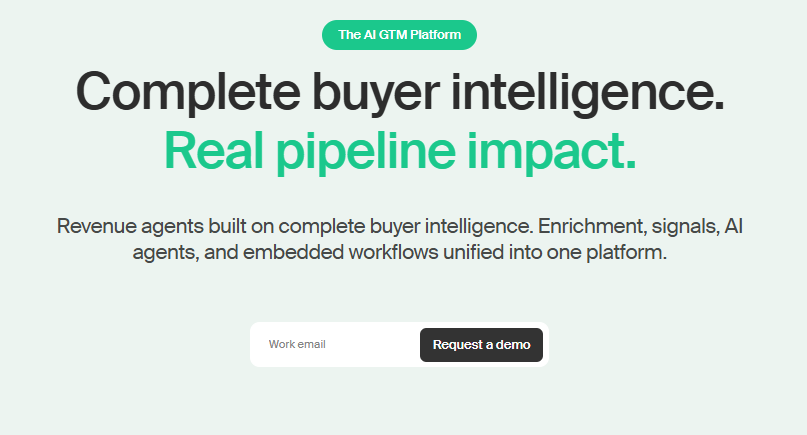
Common Room is a signal-based GTM intelligence platform that captures person-level activity across channels, community, product usage, social, and more, and turns it into prioritized, routable signals for your team. It targets the “who’s showing intent right now” question that Clay’s enrichment focus doesn’t directly answer.
Key Features of Common Room
- Person-level signal capture across multiple channels and touchpoints.
- Automations and routing to push the right signals to the right rep.
- Enrichment and CRM sync to action signals quickly.
Pros of Common Room
- Excellent for unifying scattered intent signals into one view.
- A free plan lets smaller teams start without commitment.
Cons of Common Room
- Higher tiers move to custom pricing that can climb quickly.
- More of a signal/orchestration layer than a contact database.
Common Room Compared With Clay
Common Room answers timing; Clay answers data. If your bottleneck is knowing when accounts are in-market rather than enriching a static list, Common Room is the more relevant tool, and it pairs well with an owned-data platform for the contact side.
7. Warmly
About Warmly
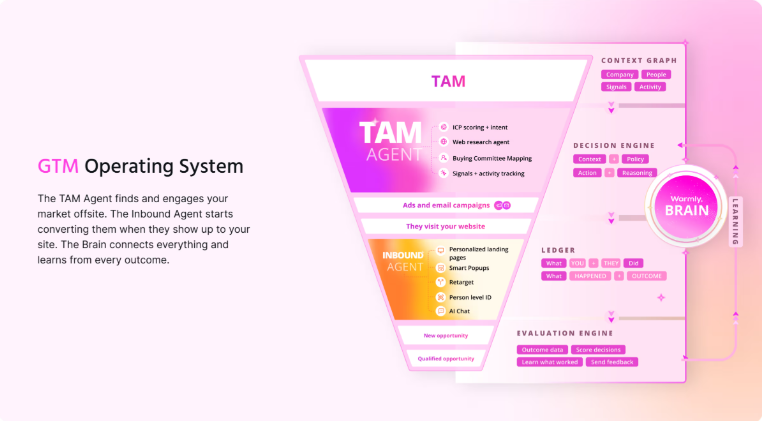
Warmly focuses on warm leads: it de-anonymizes website visitors at the person level, tracks real-time intent, and orchestrates immediate outreach while a prospect is still hot. For teams whose best opportunities are already on their site, Warmly addresses a gap Clay doesn’t cover.
Key Features of Warmly
- Website visitor de-anonymization to identify anonymous traffic.
- Real-time intent tracking to engage prospects at peak interest.
- Automated orchestration across chat, email, and sales alerts.
Pros of Warmly
- Captures buyer interest the moment it happens on your website.
- Combines intent and action data to convert warm traffic.
Cons of Warmly
- Paid plans start materially higher than Clay’s entry tier.
- Value depends on having meaningful website traffic to de-anonymize.
Warmly Compared With Clay
Warmly is an inbound-signal play, while Clay is an outbound-data play. If your pipeline problem is “we get traffic but can’t tell who it is or act fast enough,” Warmly is the better fit; it complements rather than replaces a prospecting database.
8. Unify
About Unify
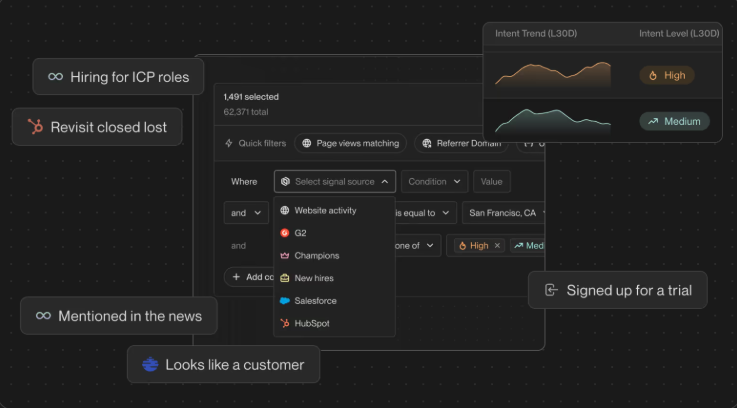
Unify is a newer agentic GTM platform built around warm outbound: it combines intent signals, AI research agents, and automated sequencing into a single flow, aiming to automate the manual orchestration that GTM engineers otherwise build by hand in Clay. It appeals to teams that want signals and execution stitched together automatically.
Key Features of Unify
- Intent and signal detection to surface in-market accounts.
- AI agents that research prospects and draft personalized outreach.
- Built-in sequencing so signals translate directly into action.
Pros of Unify
- Connects signals to execution without manual hand-offs.
- Strong fit for modern, automation-first warm-outbound motions.
Cons of Unify
- Pricing is custom and oriented to scaling teams.
- As a younger platform, depth and integrations are still maturing.
Unify Compared With Clay
Unify automates the end-to-end motion Clay leaves you to assemble, from signal to send. Clay gives you more granular control over enrichment; Unify trades some of that control for an opinionated, automated workflow that runs with less hands-on building.
What to Look for in a Clay Alternative (Buyer’s Checklist)
Before you commit to any Clay replacement, score each option against the seven criteria that separate a true GTM platform from a single-purpose tool:
- Owned data vs orchestration: Does the platform own its database (predictable accuracy and cost) or resell third-party providers on a waterfall (variable match rates and credit burn)?
- Pricing predictability: Flat subscription or metered credits? Ask what a realistic monthly bill looks like at your volume, not just the headline price.
- Built-in execution: Can you run sequences and follow-ups inside the tool, or do you still need a separate outreach platform to actually send?
- Data accuracy and verification: Look for verified emails and phone numbers and a stated accuracy rate; bounce rates directly affect deliverability and sender reputation.
- Buyer intent and signals: Does it tell you when an account is in-market, or only who they are?
- Ease of use and onboarding: Clay’s power comes with a weeks-long learning curve. If your team is SDR-led rather than ops-led, prioritize fast time-to-value.
- Integrations and compliance: Native CRM sync (Salesforce, HubSpot, Pipedrive, Zoho) and GDPR/regional compliance for the markets you sell into.
A tool that checks all seven owned data, flat pricing, native execution, verification, intent, low learning curve, and deep CRM integration, replaces several line items at once. That’s the bar Revnos.AI is built to clear, and the lens to judge every option on this list.
How to Choose the Right Clay Competitors and Alternatives
No single platform fits every team, so match the tool to your motion:
Want one platform for data, intent, and outreach?
Choose Revnos.AI, predictable pricing, and an owned database with built-in execution.
Need prospecting and email in one affordable tool?
Look at Apollo.io.
Need maximum enterprise data depth and governance?
Consider ZoomInfo.
Selling into Europe or regulated markets?
Cognism leads on compliant, verified data.
Scaling cold outreach and deliverability?
Pair in Smartlead for execution.
Bottlenecked on timing, not data?
Common Room (signals) or Warmly (website visitors) surface in-market buyers.
Want signal-to-send automation?
Unify runs an agentic warm-outbound flow.
If you would rather slash cost and tool sprawl without giving up data quality or execution, start with Revnos.AI’s free forever plan and let the results speak for themselves.
We have a list of 24 competitors for comparison. To see, click on all the comparisons.
Stop duct-taping your GTM stack together.
Get verified data, buyer intent, and built-in outreach in one platform, at a flat $99/month.
How to Switch from Clay to an All-in-One Platform (4 Steps)
Migrating off Clay is far simpler than teams expect, because you’re usually consolidating tools rather than rebuilding workflows. Here’s the four-step path most teams follow:
- Audit your current Clay spend and workflows. List the enrichment tables, the providers you’re paying for in each waterfall, your average monthly credit spend, and the separate sequencing tool you export to. This is your true cost baseline, and usually the moment the savings become obvious.
- Export your data. Pull your existing lists, enriched fields, and CRM records out of Clay and your sequencer into CSVs so nothing is lost in transition.
- Map workflows to your new platform. With an all-in-one tool like Revnos.AI, most Clay tables collapse into a single flow: pull verified contacts from the owned database, layer on buyer intent, and build cadences natively, no waterfall to configure and no export step.
- Run in parallel, then cut over. Keep Clay live for one billing cycle while you validate data accuracy and reply rates on the new platform, then cancel once you’re confident. Most teams complete the switch within one to two weeks.
Ready to make the switch?
Start free on Revnos.AI and see your verified pipeline before you cancel a single subscription.
Frequently Asked Questions
For most go-to-market teams, Revnos.AI is the best all-in-one Clay alternative because it combines an owned 600M+ contact database, buyer intent, email verification, and built-in outreach cadences at a flat $99/month, replacing both Clay and the separate sequencing tool teams pair it with. The best fit depends on your motion: Apollo for prospecting plus outreach, ZoomInfo for enterprise data depth, Cognism for compliant EU data, and Smartlead for outbound execution.
GTM stands for “go-to-market”, the strategy and the systems a company uses to bring a product to its target customers. A GTM platform unifies data, intent signals, enrichment, and outreach to turn target accounts into a pipeline.
Clay remains excellent for technical GTM engineers who want granular control over custom enrichment workflows. After its March 2026 overhaul (Launch $185/month, Growth $495/month, plus a dual-credit system), it is less budget-friendly for small teams, and it still requires a separate tool to execute outreach. Teams that want predictable pricing and built-in sending often prefer an all-in-one alternative.
Clay is a flexible enrichment and workflow engine that pulls from many third-party providers on a credit model and exports to other tools for sending. Revnos.AI owns its 600M+ contact database, includes buyer intent and email verification, and runs outreach natively at a flat $99/month. If you want one predictable platform that finds and engages prospects, Revnos.AI is the stronger choice; if you want maximum custom-workflow control, Clay has the edge.
Yes. Revnos.AI offers a Free Forever plan, Apollo.io has a free tier, and Common Room offers a free plan. Revnos.AI’s free forever plan is the most complete for teams that want data plus the ability to act on it without credit limits.

by Kapil Khangaonkar
Published on: June 4, 2026 |
Share: