
Here’s what nobody wants to admit about cold email outreach: it works brilliantly. The problem is, it rarely works for the person sending it.
The industry has been chasing the wrong metrics for years. Everyone fixates on open rates. But open rates are a vanity metric. What matters is this: the average cold email reply rate across B2B sits somewhere between 0.4% and 3%. Some teams celebrate a 1.5% reply rate.
When you do the math, that means one in fifty to one in two hundred and fifty emails gets a response. Something has gone fundamentally wrong, and it’s not because decision-makers don’t respond to cold outreach. It’s because what we’re sending doesn’t deserve a response.
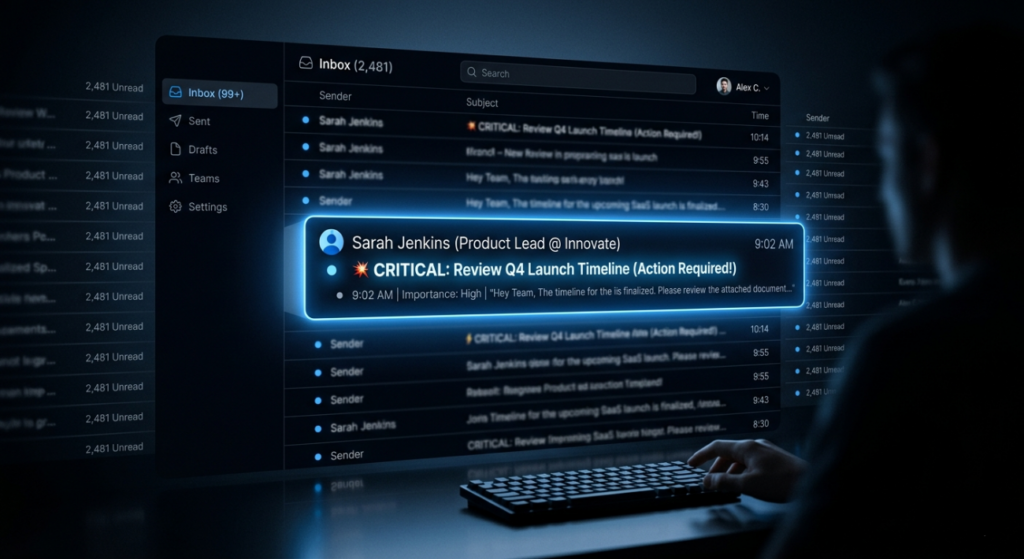
The Real Crime Scene: What Actually Kills Cold Emails
A lot of sales teams treat their first cold email outreach like a last chance. They’re gripped by the fear that they’ll never get another shot, so they cram everything into that initial message.
- The positioning
- The proof
- The benefits
- The social proof
- The calendar link
- The attachment
Basically, everything. It’s what we call the menu card approach, walking up to someone you don’t know and handing them a restaurant menu before they’ve even sat down.
Kapil Khangaonkar, founder of Revnos.AI, breaks down the psychology behind why this fails:
‘If you don’t know a person, you’re essentially going up to them and starting a ten-minute monologue without introducing yourself or getting any interest. Naturally, if that happens, the other person isn’t going to show any interest in you either. The real objective of the first email is to start a conversation, not to get a deal signed.
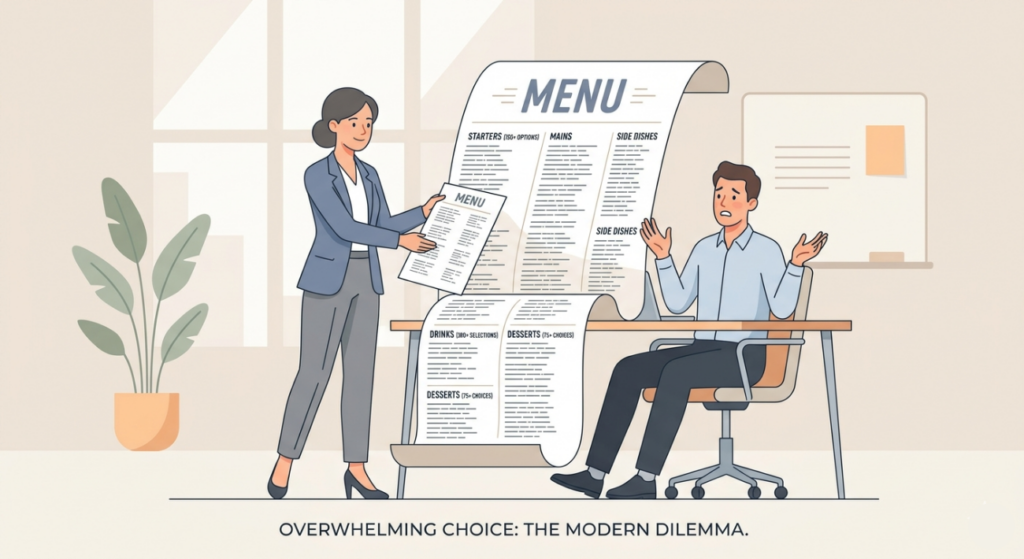
The reason this matters is technical and psychological. On the technical side, emails over 100KB trigger heavy spam filter scrutiny. Add attachments, images, multiple links, HTML formatting, and suddenly you’re carrying a virtual toolkit through a metal detector. The filters flag it immediately. But there’s a deeper reason why outbound sales emails with everything in them fail: they announce themselves as sales pitches before anyone reads them.
This is where most analysis of cold email outreach stops. It talks about technical fixes, SPF, DKIM, DMARC records, email size, and link counts. Those matters enormously. But they’re table stakes. The reason 99% of cold emails end up in spam or get deleted isn’t because of technical errors. It’s because the person who receives it can tell within the first few lines that they’re one of thousands.
The Personalization Lie We All Believe
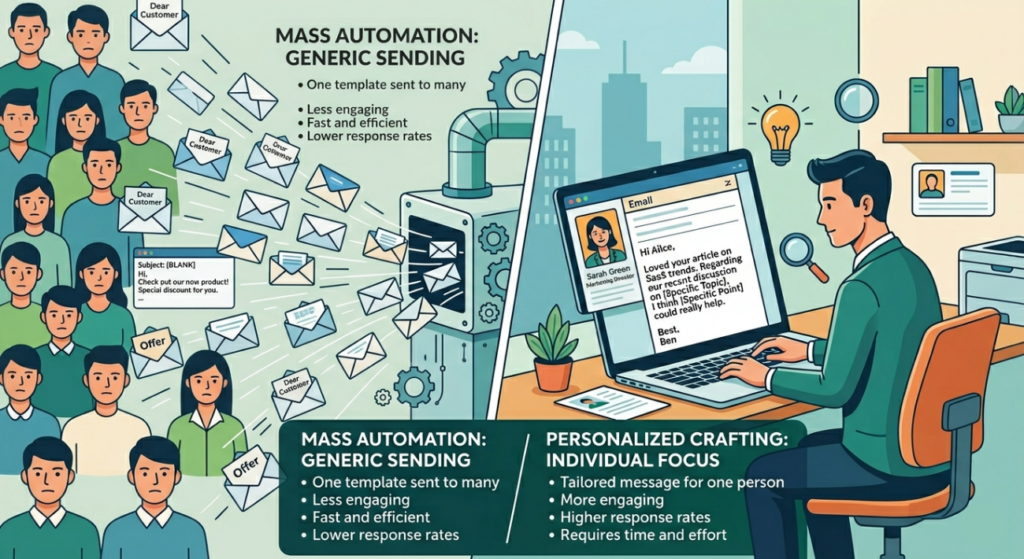
Modern spam filters are smart. Smarter than most sales teams think. If you send the same email to one hundred people with only the first name and company name changed, spam filters detect it as a generic email. That’s not cold email personalization. That’s automation pretending.
The definition of spam isn’t unsolicited email; it is generic email. The moment you’re sending a hundred variations of the same template, you’re filling an inbox with spam, regardless of whether you have someone’s permission.
Real personalization requires something different. It means demonstrating that you understand their specific world including their company, their competitive pressures, recent announcements or moves, etc.
The problem they’re probably facing at this exact moment is scale. How do you write a hundred genuinely personalized emails without spending eight hours a day on copy? The answer most teams arrive at is: you don’t. You send out mediocre template variations and accept mediocre reply rates as the cost of doing business.
The Five-Email Framework That Actually Works
Here’s the insight that changes everything:
The goal of the first email is not to close a deal; it is to create interest and curiosity.
Most sales teams understand that they need to follow up. But they structure cold email follow-ups wrong. They treat each email as an independent pitch. Email one: ‘Here’s what we do.’ Email two: ‘Just checking in.’ Email three: ‘Did you see my last email?’ This approach is backwards.
The best-performing B2B cold email campaigns follow a structured five-phase progression:
- Email 1 – The Hook: Spark curiosity. Introduce a tension or observation without pitching anything. Aim for 400-600 words, enough space to establish credibility and context, but short enough that someone will actually read it. Include a soft call-to-action: ‘Does this sound worth a conversation?’ Just a gentle prompt to see if there’s interest.
- Email 2 – Value Drop: Show a glimpse of value, not the whole thing. Recap the problem you identified in email one. Add two or three more specific details about how it impacts them.
- Email 3 – Proof: This is where you actually show your work. Case study. Specific results. Numbers. This is the email that converts most meetings because by now, the person has invested five to seven minutes reading your messages.
- Email 4 – Bump: If they’ve opened emails one through three but haven’t replied, send a reminder. Recap the conversation so far and ask again.
- Email 5 – Breakup: If they haven’t responded to all of the above, end cleanly. ‘It’s fine if this isn’t the right time. I’ll circle back later.’ A graceful exit leaves the door open. It also tells the prospect you respect their time.
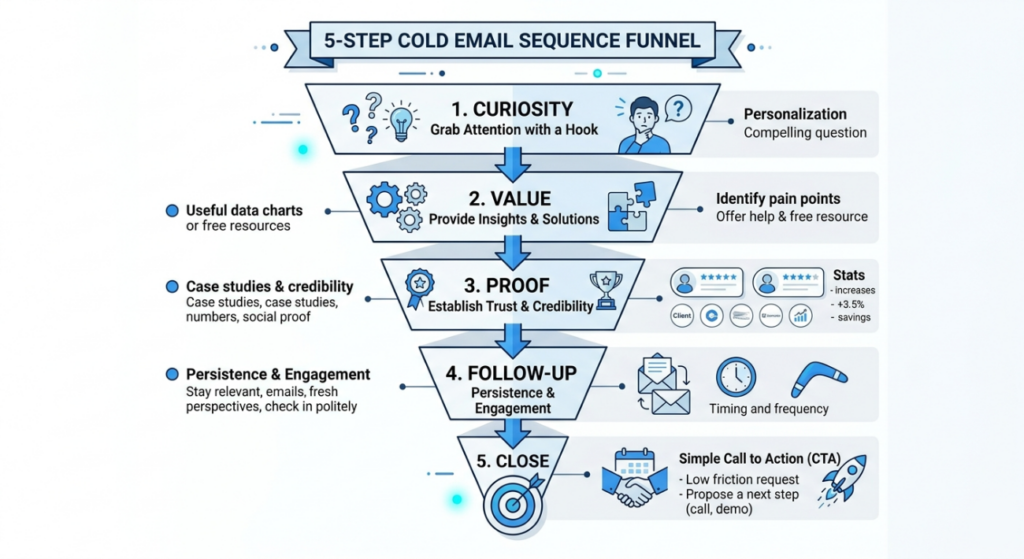
This structure works because it mirrors how real human relationships form. You don’t ask someone for a 30-minute coffee date within the first ten seconds of meeting them. Instead, you establish rapport, demonstrate value, and build trust before asking for commitment.
The Writing Styles That Actually Land
Here’s where most cold email training fails: it teaches you a single formula.
- Write this opener.
- Use this structure.
- Add social proof here.
But humans don’t all respond to the same message. A VP responds differently than a director. Someone in Boston communicates differently than someone in San Francisco. A manufacturing executive has different triggers than a software CTO.
Cold email research from thousands of campaigns shows eight core writing styles that work across different personas:
- Challenger (challenge the norm)
- Storyteller (lead with narrative)
- Data-Led (use numbers)
- Consultative (ask about industry trends)
- Direct (straight to the point)
- Pattern Interrupt (say something unexpected)
- Relationship (show investment)
- Empathy-Based (acknowledge pain)
One thing you need to understand is that different people need different messages. A VP of Sales and a Procurement Director at the same company won’t reply to the same email. An engineer won’t respond the same way as a CFO. Yet most teams send the same message to everyone and wonder why reply rates tank.
The Technical Foundation That Determines Deliverability
Every argument about cold email deliverability eventually hits this wall: technical deliverability. If your email doesn’t reach the inbox, none of the copy matters.
Three authentication protocols determine whether your emails are trusted:
- SPF (Sender Policy Framework),
- DKIM (DomainKeys Identified Mail)
- DMARC (Domain-based Message Authentication, Reporting, and Conformance).
These aren’t optional. They’re certification standards that tell receiving mail servers: this sender is who they claim to be.
If these are set up incorrectly, every email you send gets marked as spam at multiple layers: your ISP level, the recipient’s ISP, their email client’s spam filter. You’re essentially building a campaign on an unstable foundation.
Check your setup using MX Toolbox. Go to mxtoolbox.com and search your domain. All three records should show green. If they don’t, talk to your IT team before you send another email.
Beyond authentication, payload size matters. Email under 100KB bypass heavy spam scanning. The moment your email crosses 100KB, every filter scrutinizes it. Keep your first email text-based, minimal images, no attachments. Once they open it and reply, you’re automatically marked as a trusted sender. Then subsequent emails can be richer.
One more critical rule: one URL per email, maximum two. Every URL in an email, including social media links in your signature, counts. Multiple URLs trigger spam filters. If you must link something, use clean links from Google Drive or OneDrive. These are trusted sender by most mail systems because Gmail and Outlook recognize them as legitimate.
Cold Email Outreach Subject Lines: Your First Impression
Everyone knows ‘Quick question’ doesn’t work anymore. Everyone sees it as a sales pitch. The same goes for ’15 minutes of your time,’ ‘Act now,’ and anything with the word ‘free.’
What actually works: subject lines that reference something specific to them. Companies that just got funded. Executives who recently changed roles. Companies using a specific tech stack. A recent announcement they made. Anything that signals: ‘I know something about you, and I have a reason for writing this specific email to you.’
The trick to scaling this: segment your contact list by characteristics that warrant a shared subject line. Don’t write two hundred different subject lines. Instead, bucket prospects: recently funded companies, job changers, companies expanding into new markets, companies using specific technology. Then write subject lines for those buckets.
This approach, segmenting first, then writing, is how you maintain personalization at scale without manually writing every email.
Best Email Tools for Cold Email Outreach
There’s a widespread misconception about email tools. People ask: ‘Can I use HubSpot to send cold emails?’ The answer is technically yes and legally no.
HubSpot explicitly states in their terms that you cannot use their platform to send emails to prospects whose explicit consent you haven’t obtained. This restriction applies to every bulk email platform: MailChimp, Marketo, SendGrid. The reason: these tools are built for marketing to existing audiences, not cold outreach.
Here’s the distinction: bulk email tools use shared IP addresses. Thousands of senders use the same IP pool. When one sender spams, it damages the reputation for everyone. Cold email outreach tools like SalesLoft, Outreach, and Revnos.AI ask you to connect your own email account. The email comes from your domain, your IP reputation.
Additionally, bulk tools are designed for high volume with lower accuracy, i.e., send ten thousand emails, hoping for a three percent response rate. Cold email outreach tools prioritize quality, which is to send three hundred emails daily, expect thirty to fifty percent open rates, and four to five percent replies. Different tools for different jobs.
Cold Email Isn’t Broken; Your Approach Is
If your cold email outreach isn’t working, it’s not because cold email is broken. It’s because the approach is broken. Somewhere in your process, you’re choosing scale over relevance. Volume over craftsmanship. Speed over research.
Decision-makers still respond to cold outreach. They respond to outreach that’s relevant, timely, and written with evidence that someone actually studied them. What’s dying is tolerance for outreach, that’s none of those things.
The teams getting thirty, forty, fifty percent of cold email reply rates aren’t doing anything magical. They’re not using secret templates or spammy tactics. They’re applying a straightforward principle: write emails as if you’re reaching out to one person, even when you’re reaching out to thousands. Research each person. Understand their context. Choose the writing style and message sequence that fits them. Let proof and specificity do the work that urgency and pressure can’t.
If you’re not sure whether your current approach is that, if you’re wondering whether you’re optimizing for the right things, that’s worth figuring out soon. The gap between mediocre cold email and great cold email has never been bigger. And the teams that close it will have a structural advantage that gets harder to match with every quarter that passes.
Frequently Asked Questions
Cold email outreach is sending unsolicited but personalized emails to prospects with whom you have no prior relationship. In B2B sales prospecting, it remains highly effective because it reaches decision-makers directly, doesn’t rely on algorithms, and when done correctly achieves 30-50% open rates and 4-5% reply rates. The key differentiator is research-backed personalization and structured follow-up sequences.
Emails land in spam for technical and content reasons. Technically: SPF/DKIM/DMARC records are misconfigured; emails exceed 100KB; you’re using a bulk platform with shared IP; or sending multiple URLs per email. Content-wise: sending generic templates; using spammy keywords like ‘Act now,’ ‘Free,’ or ‘ChatGPT’; using emojis in subject lines; or including calendar booking links. Use MX Toolbox to audit your domain setup.
Research consistently shows that five-email sequences outperform both shorter and longer chains for B2B cold email outreach. The five-phase framework, Hook, Value Drop, Proof, Bump, Breakup, mirrors natural relationship-building and gives prospects multiple touchpoints without feeling harassed. The key is that each email builds on the last rather than repeating the same pitch. Most meetings are booked after the third or fourth email, so stopping at one or two follow-ups means leaving a significant portion of interested prospects on the table.
The secret to scaling email personalisation is segmentation before writing, not personalisation after templating. Group your prospects by meaningful shared characteristics: funding stage, tech stack, hiring signals, recent news, or job change. Then write one deeply personalised email for each bucket. Within each bucket, every email genuinely reflects that prospect’s situation, because they all share the relevant characteristic. AI-powered tools like Revnos.AI can surface these signals automatically, so your sales team spends time on outreach rather than research.
Cold emails should be 400-600 words for maximum open and reply rates. Too short (under 150 words) doesn’t allow space for genuine personalization. Too long (over 800 words) signals you’re trying to close a deal. The 400-600 word sweet spot allows you to include a specific hook, reference the prospect’s context, mention a problem they face, hint at how you’ve solved it, and end with a soft CTA. Keep formatting simple, text-based, no HTML, images, or attachments, to stay under the 100KB threshold.

by Kapil Khangaonkar
Published on: June 1, 2026 |
Share: