
Cold email is not dead. Bad cold email is dead. Let’s discuss cold email outreach best practices…
In 2026, most B2B sales teams still treat cold email like a volume game: buy a list, write one template, add a first name, and hope. That approach stopped working. And it is hurting the pipeline, domain reputation, and seller credibility all at once.
Before a prospect even opens your email, multiple things have already happened. Mail servers checked your domain. Spam filters reviewed the content. The inbox decides whether your message deserves attention or ends up in the trash folder.
Great cold email outreach best practices do not begin with a clever subject line. They begin with a system.
This guide covers the 7 cold email outreach best practices every B2B sales team should follow in 2026 to improve deliverability, increase reply rates, and build a repeatable outbound engine. These steps have been validated across 43 million emails analyzed on the Revnos.AI platform.
| Quick Answer: The 7 Cold Email Outreach Best Practices in 2026 1. Fix domain authentication (SPF, DKIM, DMARC) before sending anything 2. Keep every first cold email under 100 KB 3. Write subject lines that cannot be copied to another prospect 4. Use a structured cold email sequence, each email has one job 5. Personalize beyond name and company fields 6. Use AI to scale research-based personalization with human approval 7. Measure reply rate, not just open rate |
What These Steps Can Deliver: 7 Cold Email Outreach Best Practices
To set expectations honestly, here is what consistently happens when teams build a full cold email system:
| Metric | Achievable Result | Industry Benchmark | Source |
|---|---|---|---|
| Open rate | 40%+ | 27.7% average | Martal, B2B Cold Email Statistics 2026 |
| Reply rate | 4–5% | 3.43% platform average | Instantly, Cold Email Benchmarks 2026 |
| Improvement vs generic campaigns | Up to 10x | No increase in send volume | Kapil Khangaonkar, Revnos.AI Masterclass |
These are not aspirational benchmarks. They are what happens when teams implement all seven steps correctly.
Key Takeaways
- Cold email success in 2026 is a systems problem, not a copywriting problem.
- Domain authentication (SPF, DKIM, DMARC) is non-negotiable, fix it before writing a single line of copy.
- The ATLAS sequence framework (Hook, Value, Proof, Bump, Breakup) prevents repetitive follow-ups and earns higher reply rates.
- Real personalization means the email could not be sent to another prospect without editing, name and company fields alone are not personalization.
- AI SDR tools like Atlas AiSDR can research accounts and generate differentiated copy at scale, with human review before every send.
- Reply rate, not open rate, is the metric that actually tells you whether cold email is working.
Step 1: Fix Domain Authentication Before Sending Another Email
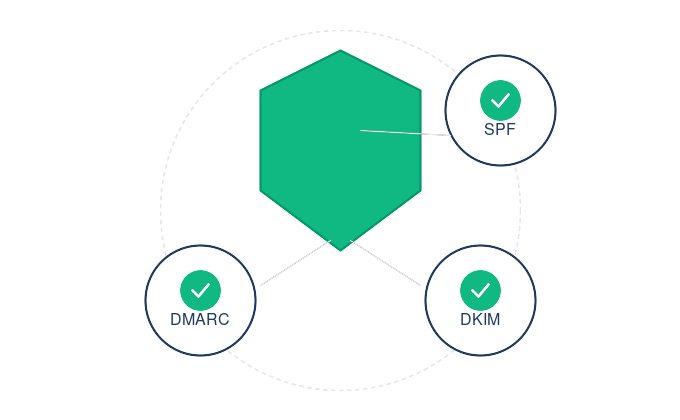
This is the unglamorous step that determines whether everything else works. Before any subject line test, copy optimization, or sequence change, your sending domain must pass three technical checks: SPF, DKIM, and DMARC.
These are the authentication records that tell recipient mail servers you are a legitimate sender. Without them correctly configured, your emails are flagged as potentially fraudulent before a human ever sees them. This is why cold email deliverability must come first.
SPF: Sender Policy Framework
Authorizes which IP addresses and tools can send email on behalf of your domain. Every outreach platform your team uses must be listed. A missing or duplicated SPF record causes authentication failures at scale. Sales teams should review their SPF settings before scaling any cold email campaign.
DKIM: DomainKeys Identified Mail
A cryptographic signature on every email you send. Proves to recipient servers that the email genuinely came from your domain and was not modified in transit. Without DKIM, inbox providers may treat your email as a risk.
DMARC
Ties SPF and DKIM together and tells servers what to do with unauthenticated emails. For cold outreach, set DMARC to ‘none’ initially. Setting it to ‘quarantine’ too early gives recipient servers direct authority to bin your emails if SPF or DKIM are not yet perfectly aligned.
How to check: run your domain through MX Toolbox. Free. No login required. Complete authentication audit in seconds.
During live Revnos.AI Masterclass sessions, the majority of participants had at least one misconfigured or unpublished record. The typical fix takes an IT administrator under ten minutes.
If SPF, DKIM, or DMARC are not correctly configured, every other optimization in your cold email program is building on a broken foundation. This is not optional.
Important: Buying multiple secondary domains to run parallel cold campaigns has stopped working. Google and Microsoft both detect and penalize this pattern. Also stay updated on Google and Yahoo email sending limits, these rules directly affect how sales teams manage authentication, spam complaints, and sender reputation.
Deliverability Checklist
| Deliverability Item | Why It Matters |
|---|---|
| SPF is configured | Confirms approved senders for your domain |
| DKIM is active | Proves email was not modified in transit |
| DMARC is published | Connects SPF and DKIM policies |
| Domain is not in the spam list | Protects sender reputation |
| Email tool is authorized | Prevents failed authentication |
| Sending volume is controlled | Avoids sudden spam signals |
| Bounce rate is monitored | Protects long-term domain health |
Step 2: Keep Every First Cold Email Under 100 KB
Once authentication is clean, the next foundation layer is file size. This is one of the most ignored cold email outreach best practices.
Emails under 100 KB pass through basic filtering. Emails above 100 KB face the full spam check gauntlet. It is binary, cross the threshold by 1 KB and your email faces maximum scrutiny from inbox providers.
What Makes Cold Emails Too Heavy?
| Problem | Fix |
|---|---|
| Large logo in signature | Remove or compress it |
| Social media icons | Remove them from cold email signatures |
| HTML-heavy templates | Switch to plain text |
| Attachments | Replace with a link, or avoid in the first email |
| Long signature | Keep only name, role, company, website |
| Multiple links or tracking scripts | Use one link at most in the first touch |
Your first cold email should look like a real person wrote it, not a newsletter. Plain text consistently outperforms designed HTML templates in cold outreach because it looks human, loads fast, and passes filters cleanly.
Step 3: Write Cold Email Subject Lines That Cannot Be Copied to Another Prospect
Cold email subject lines have one job: get the email opened. Cold email does not close deals. They do not pitch your product. They make a person click, and then they get out of the way.
The subject lines that fail most reliably are the most commonly used: ‘Quick question’, ’15 minutes of your time’, ‘As discussed’, anything with an emoji. Experienced B2B buyers identify these in under a second.
The Test for a Good Subject Line
| Could this subject line be sent to another prospect without changing anything? If yes, it has already lost its only useful quality. |
Subject Line Examples: Weak vs. Strong
| Weak Subject Line | Better Subject Line |
|---|---|
| Quick question | Noticed your SDR hiring push |
| 15 minutes? | Idea for {{Company}} outbound |
| Sales automation | {{Company}} pipeline coverage gap |
| Increase your leads | Thought on your APAC expansion |
| Following up | Worth revisiting after Q1? |
| Growth opportunity | {{Competitor}} pricing shift, relevant to {{Company}} |
Subject Line Best Practices
- Keep subject lines between 6–8 words, roughly 85% of business email is opened in Outlook vertical panel view, where only 6–8 words are visible before truncation.
- Use simple, specific, natural language with one clear idea.
- Avoid emojis (signals AI-generated copy), spam words like ‘free’ or ‘act now’, fake urgency, and misleading ‘Re:’ or ‘Fwd:’ prefixes.
- Reference something specific to this recipient’s company, role, or situation, a hiring trend, competitor move, product launch, or market shift.
Step 4: Structure Every Cold Email Sequence So Each Email Has One Job
The most common cold email mistake is sending five versions of the same email and calling it follow-up. It is not a follow-up. It is repetition, and spam filters treat it as bulk mail.
Fixing this single cold email mistake i.e giving each email a distinct purpose, is often the fastest way to improve reply rates without changing anything else.
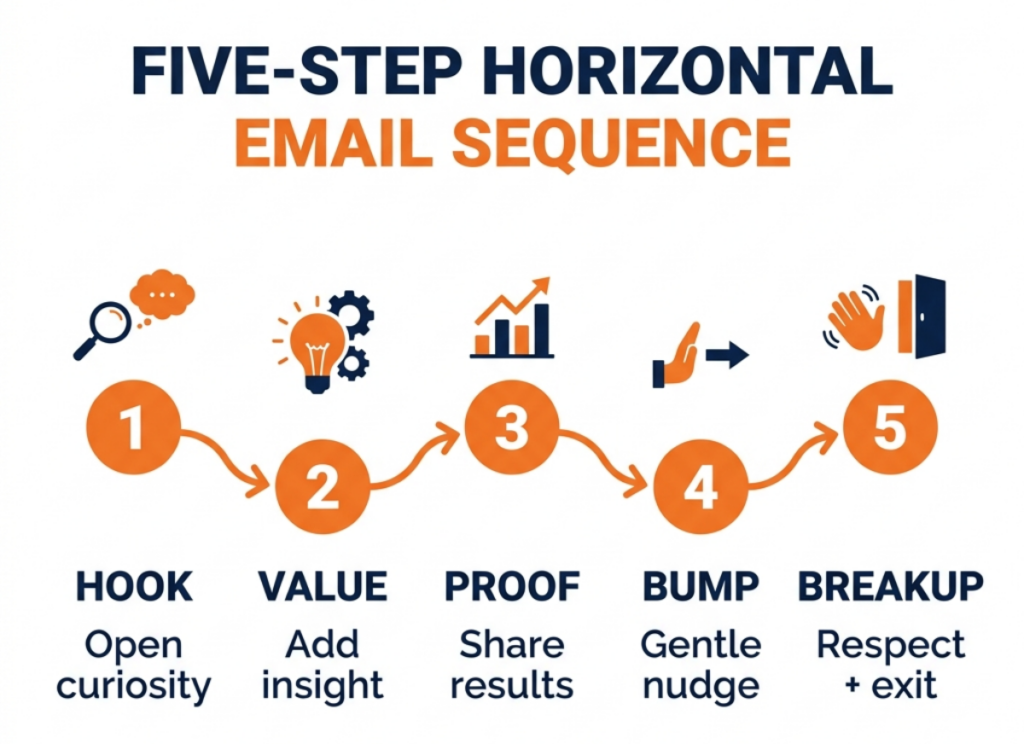
The ATLAS Cold Email Sequence Framework
| Purpose | What It Should Do | |
|---|---|---|
| Email 1 – Hook | Generate curiosity | Reference something specific. Ask an open question. Leave gaps. Do not pitch yet. |
| Email 2 – Value | Share useful insight | Give a relevant observation, data point, or problem they likely face. Add something new. |
| Email 3 – Proof | Build trust | Social proof belongs here, not in Email 1. Use a specific customer story: type, problem, result, timeframe. |
| Email 4 – Bump | Nudge gently | Two or three lines. A fresh angle or gentle nudge. Not a restart. |
| Email 5 – Breakup | Close respectfully | Step back gracefully. Wish them well. Leave the door open. Often the highest-reply email in the sequence. |
Anatomy of a Strong First Cold Email (Under 80 Words)
- A personalized opener referencing something specific: a recent event, their role, a market they operate in
- A bridge connecting their situation to the problem you solve, without naming the solution yet
- A curiosity gap: a teaser, data point, or contrarian observation. Introduce it. Do not answer it.
- A soft CTA: ‘Worth a conversation?’ or ‘Curious if this resonates?’ Not ‘Can we schedule 30 minutes?’ That is too much, too soon.
Example: Email 1 – The Hook
| Subject: Noticed {{Company}} hiring SDRsHi {{First Name}},Noticed {{Company}} is expanding the SDR team this quarter.When outbound teams scale quickly, one challenge is keeping every email personalized without slowing reps down.We recently saw a way to keep personalization consistent without adding research time.Curious if this is something your team is looking at?Best,{{Sender Name}} |
Step 5: Personalize Cold Emails Beyond Name and Company Fields
Swapping a first name and company name into a template is not personalization. It is a mail merge. Spam filters treat it as bulk mail. Buyers treat it as noise.
The spam definition that matters for cold email deliverability is not unsolicited email. It is a generic email. If the same content is going to 200 people with only the name changed, spam filters catch it.
Levels of Cold Email Personalization
| Level | Example | Quality |
|---|---|---|
| Basic mail merge | Hi {{First Name}}, saw you work at {{Company}} | Weak |
| Segment-based | Noticed many SaaS teams struggle with outbound reply rates | Better |
| Trigger-based | Saw {{Company}} is hiring 8 SDRs this quarter | Strong |
| Role-based | As VP Sales, pipeline quality is likely more important than email volume | Strong |
| Research-based | Your new mid-market focus may require different messaging for RevOps vs Sales leaders | Best |
Using Buyer Intent to Strengthen Personalization
Cold email performs significantly better when it is timed to a signal. A company hiring SDRs, expanding into a new region, or increasing technology spend is a warmer target than a random account from a static list. That is why combining personalization with buyer intent signals dramatically improves reply rates. Intent data helps sales teams understand which companies may already be showing urgency around a problem you solve.
| The Test: If you swapped the name and company, would the email still make sense for the next prospect? If yes, it is a template with a name tag. Spam filters know this. So do buyers. |
Step 6: Use AI to Scale Cold Email Personalization at Scale, Without Degrading Quality
Genuine personalization works. But it is slow at scale. A sales rep can research 10 accounts deeply. What happens when the team needs to reach 500 accounts?
Most companies fall back to templates. That is the problem that kills cold email outreach performance at volume.
The better solution: use AI for research-based cold email personalization at scale. This is where AI for sales prospecting becomes essential. AI can collect account context, identify patterns, understand prospect needs, and create more relevant outreach at a scale that manual research cannot support.
What Atlas AiSDR Does Differently
| Capability | Traditional Outreach Tools | Atlas AiSDR by Revnos.AI |
|---|---|---|
| Sends email sequences | Yes | Yes |
| Name/company field merge | Yes | Yes |
| Company context research | Limited | Yes (before writing a word) |
| Buyer persona mapping | Limited | Yes |
| Unique message angles per prospect | Limited | Yes |
| Personalizes by role and industry | Limited | Yes |
| Human-in-loop approval | Sometimes | Always (AI drafts, human approves) |
| Built for research-first outreach | No | Yes |
| Cost per email | $1.50–$2.00 (comparable tools) | $0.045 |
Atlas AiSDR operates with eight built-in writing styles:
- The challenger
- The consultative
- The storyteller
- The direct,
- The data-led
- The pattern interrupt
- The relationship-first
- The Empathy/Gap Selling.
These are selected per prospect based on role, industry, and seniority.
The AI writes. The human reviews and approves. The email is sent. Every piece of outreach passes through human review before it scales. No rogue campaigns. No brand risk.
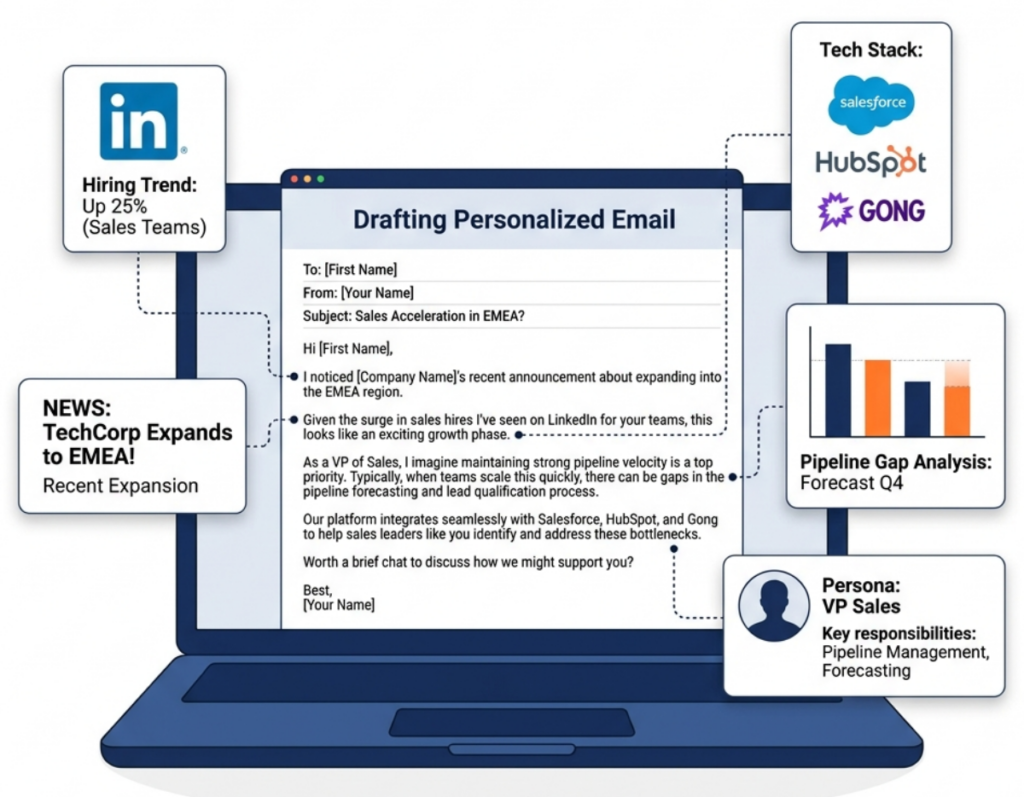
Source: Revnos.AI Atlas AiSDR, Cold Email Masterclass Webinar
Step 7: Measure Cold Email Reply Rate, Not Just Open Rate
Most teams measure open rates and celebrate any movement. Open rates are increasingly unreliable since Apple Mail Privacy Protection began pre-loading tracking pixels, inflating numbers for Apple Mail users.
The metric to optimize first is reply rate. It is the only number that cannot be inflated by tracking quirks and directly represents a prospect making a deliberate decision to engage.
Cold Email Benchmarks 2026
| Metric | Healthy Benchmark | What It Tells You | Source |
|---|---|---|---|
| Open rate | 30%+ (floor), 40%+ achievable | Deliverability + subject line strength | Martal, B2B Cold Email Statistics 2026 |
| Reply rate | 3%+ basics working, 4–5%+ optimized | Message relevance and sequence quality | Instantly, Cold Email Benchmarks 2026 |
| Bounce rate | Below 2% | Contact data quality | Belkins, B2B Response Rates Study 2025 |
| Spam complaint rate | Below 0.1% | List relevance and targeting | Google Sender Guidelines 2025 |
Diagnosing Poor Campaign Performance
| Problem | Likely Cause | What to Fix |
|---|---|---|
| Low open rate | Deliverability, subject line, spam triggers | Check SPF, DKIM, DMARC, email size, subject line specificity |
| Opens but no replies | Weak copy or poor personalization | Improve message angle and CTA |
| High bounce rate | Stale or unverified contact data | Verify emails before sending |
| Spam complaints | Generic messaging or poor targeting | Improve list quality and personalization |
| Replies only on breakup email | Emails 1–4 too pitch-heavy | Make earlier emails more useful, less aggressive |
Measure performance by campaign, segment, persona, email step, subject line, message angle, and industry. Knowing which email in your five-touch sequence gets the most replies tells you where engagement is actually happening.
Build It Once, Run It Every Quarter: The Repeatable Cold Email System
Cold email done right is not a campaign. It is a system.
The foundations you build do not need to be rebuilt each quarter. Server authentication does not need reconfiguration every month. The ATLAS sequence structure does not need reinvention for each campaign. Once in place, the variable work becomes segmentation, personalization inputs, and proof points. This is exactly where human judgment adds the most value.
Cold email also works best as part of a larger B2B sales prospecting strategy, connected to account intelligence, contact data quality, and outbound lead generation processes that feed the right accounts into the system.
The Repeatable Cold Email System Checklist
Deliverability
- SPF configured
- DKIM configured
- DMARC published
- Domain not spam listed
- Sending tool authenticated
- Bounce rate monitored
- Sending volume controlled
Email Quality
- First email under 100 KB
- No attachments in first email
- Signature is minimal
- Subject line is specific and non-generic
- Email under 80–120 words
- CTA is soft and easy to answer
- Message has one clear idea
Personalization
- Email references a real company detail
- Message is relevant to the prospect’s specific role
- Pain point connected to real business context
- Copy would not work for another prospect without editing
- Follow-ups each add new value
- Human review included before sending
Measurement
- Open rate tracked (as directional, not primary metric)
- Reply rate tracked (primary metric)
- Bounce rate tracked
- Spam complaints tracked
- Performance reviewed by sequence step
- Winning angles reused and documented
Conclusion: 7 Cold Email Outreach Best Practices
The Cold Email That Survives Is the One That Deserves the Reply.
Cold Email Outreach Best Practices in 2026 is not about sending more messages. It is about sending better ones.
If your domain setup is weak, emails will not reach the inbox. The subject lines are generic; buyers ignore them. If follow-ups repeat the same pitch, prospects tune out. If personalization is only name and company, it reads like every other automated sequence.
Cold email can still generate a real pipeline, only when you build the right system. This includes points such as clean authentication, lightweight emails, specific subject lines, a structured sequence, research-based personalization, AI-assisted scale with human approval, and reply-rate tracking.
| The cold email is not dead. Bad cold email is dead. The ones that survive are the ones that deserve to. |
If you have not already addressed the foundational errors, start with the companion piece: 7 Mistakes That Are Killing Your Cold Email Outreach.
Ready to see what research – first, governed AI outreach looks like in practice?
Book a live demoFrequently Asked Questions
The best cold email outreach best practices in 2026 are: setting up SPF, DKIM, and DMARC correctly; keeping emails under 100 KB; writing specific subject lines; using a structured five-email sequence; personalizing with real research; using AI for personalization at scale with human review; and tracking reply rate as the primary success metric.
A good cold email reply rate is 3% or higher, which signals the basics are working. A reply rate of 4–5% shows that sequence structure and personalization are both working well. According to Instantly’s Cold Email Benchmarks 2026, the platform-wide average across billions of emails is 3.43%. Campaigns built on a full seven-step framework consistently exceed this.
The ATLAS framework assigns a distinct purpose to each of five email positions: Hook (generate curiosity), Value (share useful insight), Proof (build trust with a specific customer story), Bump (a short, respectful nudge), and Breakup (step back gracefully and leave the door open). Each email does one job. This is what separates a working cold email sequence from five versions of the same pitch.
An AI SDR (AI Sales Development Representative) helps with sales development tasks including account research, prospect analysis, message drafting, personalization, and sequence support. For cold email outreach, an AI SDR reduces manual research time and helps sales teams create more relevant, research-based emails at scale, with human approval built in before sending.

by Kapil Khangaonkar
Published on: June 1, 2026 |
Share: