
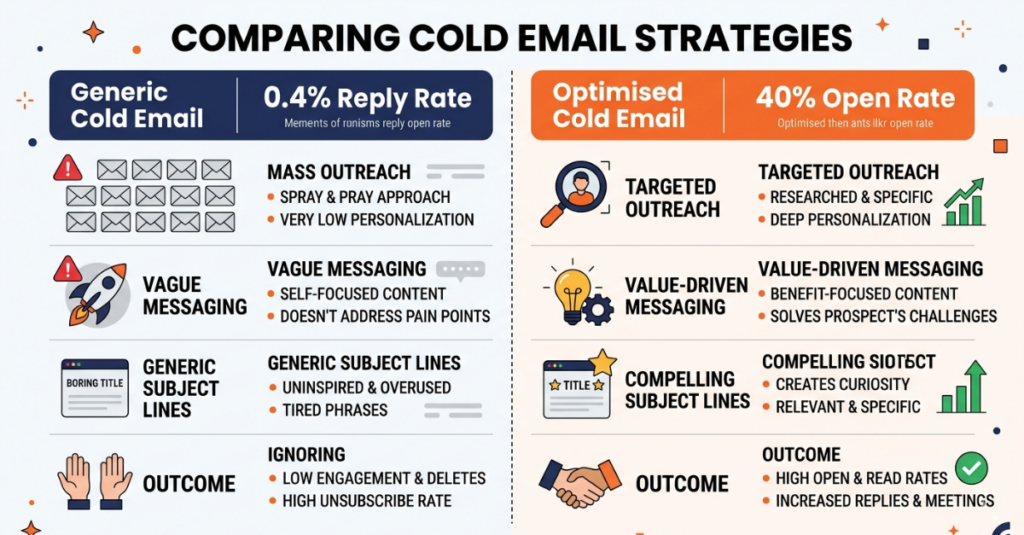
If your reply rates are stuck below 2%, the problem is not your product, your pitch, or your prospect list. It is the seven cold email mistakes most teams do not even know they are making.
Most cold email mistakes start in the wrong place.
It assumes the email copy is the problem. So you rewrite the subject line. You trim the word count. You A/B test the CTA. Reply rates nudge up by 0.3%, then plateau. Nothing fundamentally changes.
Here is what is actually going on: most cold email programs are built on broken infrastructure. The cold email campaign mistakes happening underneath the copy, before a single human being reads a word, are the ones doing the damage.
After running the Cold Email Masterclass and analysing data from tens of millions of emails sent through the Revnos.AI platform, Kapil Khangaonkar identified seven specific cold email outreach mistakes that appear in the campaigns of almost every team struggling with cold email outreach. They are not obscure edge cases. They are decisions teams make every day without realising the consequences.
Fix these seven cold email mistakes and the response rate math changes dramatically. Not incrementally. Dramatically.
Where Does Cold Email Actually Stands?
Before the cold email deliverability mistakes, the numbers. Because the gap between where most teams are and where they could be is genuinely shocking once you see it.
~1–5% average B2B cold email reply rate, most generic campaigns sit at the floor of that range
Source: Martal, B2B Cold Email Statistics 2026
28% of a sales rep’s week is spent actually selling, the rest disappears into admin and tab-switching
Source: Salesforce, State of Sales Report (5th Edition)
What does a functioning B2B cold email mistakes prevention program look like? Based on Kapil’s analysis of campaigns run through the Revnos.AI platform, teams that fix the fundamentals typically reach:
- 40%+ open rates (vs. the 27.7% industry average for cold outreach)
- 4–5% reply rates (vs. the 1–3% most generic campaigns see)
- 10x improvement over generic campaigns, with no increase in send volume
The difference between those two outcomes is not better copywriting or more budget. It is the seven things below.
7 Cold Email Mistakes That Are Killing Your Outreach
Think of this as a crime scene investigation. Most cold email outreach mistakes are not accidental. They are the result of specific, identifiable decisions made every day without realising the consequences.
Cold Email Mistake #1: Sender’s Greed, Trying to Close in Email One
Walk up to a stranger at a conference. Before they say a word, hand them a 12-page brochure, explain your full product suite, and ask for a 30-minute call. See how that lands.
That is what most first cold emails do. The logic is understandable: the sender worries they will not get another chance, so they try to say everything at once. The result is an email that takes four minutes to read, answers questions the prospect has not asked, and immediately signals that the sender is more interested in talking than listening.
The first email has one job: generate enough curiosity that the prospect either replies or opens the next. Everything else belongs in emails two and three. That is where conversions actually happen.
Think of it like a first date. You do not propose at the first meeting. The objective is to start a conversation, not to answer every possible question the prospect could ever have.
The fix: One email. One idea. One open-ended question. If your first email could double as a company brochure, rewrite it.
Cold Email Mistake #2: The 100 KB Ceiling Nobody Mentions
This is the most underrated technical failure in cold email deliverability mistakes, and it operates entirely below the surface. Most teams have no idea it is happening.
Every email client applies a size threshold: emails under 100 KB pass through basic filtering. Emails above 100 KB get subjected to every spam check in the system.
There is no middle ground. It is binary. Cross the threshold by 1 KB and your email faces the full gauntlet.
The contributors to crossing that threshold are almost always invisible to the sender:
- Company logos embedded in signatures
- Social media icons (LinkedIn, Twitter, YouTube) in the email footer
- HTML formatting, image assets, and styling code
- Any PDF or document attachment (which can push a 40 KB email to 400 KB instantly)
The fix: Plain text first email. Strip the signature to name, title, and phone number. Compress any mandatory logo. Send the email to yourself, download it, and check the file size. If it exceeds 100 KB, find what is adding weight and remove it. This single fix has more impact on inbox placement than any subject line optimisation.
Cold Email Mistake #3: Attachments, The Fastest Route to the Junk Folder
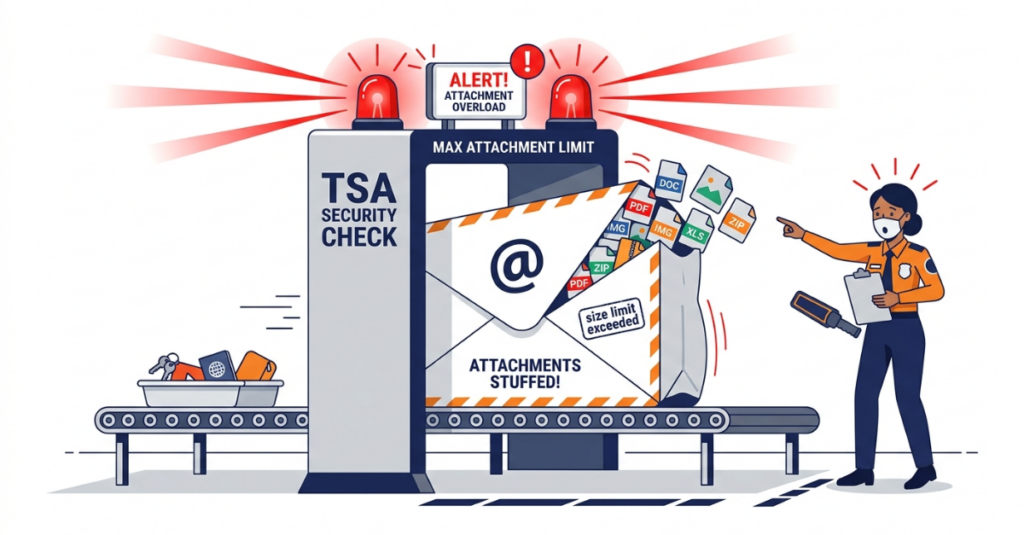
At some point in B2B sales history, someone decided attaching a company brochure to a cold email was a good idea. It was not.
An attachment on a first cold email does several things simultaneously, all harmful:
- Spikes email file size, almost certainly crossing the 100 KB threshold
- Triggers security scanning protocols designed to catch phishing and malware
- Signals to spam filters that this matches the pattern of bulk commercial mail
- Tells the human reader this is a broadcast, not a personal message
This is one of the most critical cold email campaign mistakes in outreach strategy.
Nobody wants to learn more about you before they decide you are worth knowing. Your company deck can wait until email three. By then they have seen your name twice and have a reason to open it.
The fix: Mention the resource without including it. Tell the prospect you have a relevant case study and offer to send it when they reply. The reply to unlock the resource is itself a low-friction CTA.
Cold Email Mistake #4: The Link Trap, One Is the Maximum
Every URL in a cold email is evaluated by the recipient’s spam filter. Every single one. Not just the links in the body copy.
Your company website in the signature? A link. Your LinkedIn profile icon? A link. The three social media buttons your company mandates at the bottom of every employee email? Three links. The Calendly URL you added to make it easier for the prospect? A link that carries extra penalties.
The safe threshold for cold outreach is one URL per email. Two is risky. Three or more is a near-guarantee of spam filtering. Teams are regularly landing in junk folders solely because their mandatory signature template contains six social media icons.
This represents one of the biggest reasons why cold emails go to spam issues that remain invisible to senders.
On Calendly specifically: beyond the spam penalty, embedding a booking link in a first cold email sends an interpersonal signal that lands badly. It communicates that your time is more valuable than the prospect’s.
The fix: Offer specific times in plain text. “Would Thursday between 3 and 5 PM work? Or Friday morning?” This bypasses the spam filter and sounds like a human, not a system.
Cold Email Mistake #5: The Length Problem, Both Extremes Fail
There is a persistent myth that cold emails should be as short as possible. This produces 150-word emails that are technically brief but have nothing to say, no personalisation, and no compelling reason to reply.
There is also the opposite: emails that run to 1,200 words because the sender wants to be thorough. No stranger is going to read 1,200 words from someone they have never heard of.
400–600 words the sweet spot for maximum cold email open rates, based on analysis of 43 million emails sent through the Revnos.AI platform
Source: Kapil Khangaonkar, Revnos.AI Cold Email Masterclass (43M email dataset)
This optimal cold email reply rate range is one of the most consistently ignored aspects of cold email best practices.
The fix: 400 to 600 words gives you enough space to personalise, establish relevance, create a curiosity gap, and close with a soft CTA. Under that range you cannot do all four. Over that range you are asking for reading time a stranger will not give you.
Cold Email Mistake #6: The HTML Disguise, Looking Like a Campaign
There are two different types of outbound email. Marketing emails create awareness and go to subscribed lists. Sales emails generate meetings and go cold. These require completely different formats, and mixing them up is expensive.
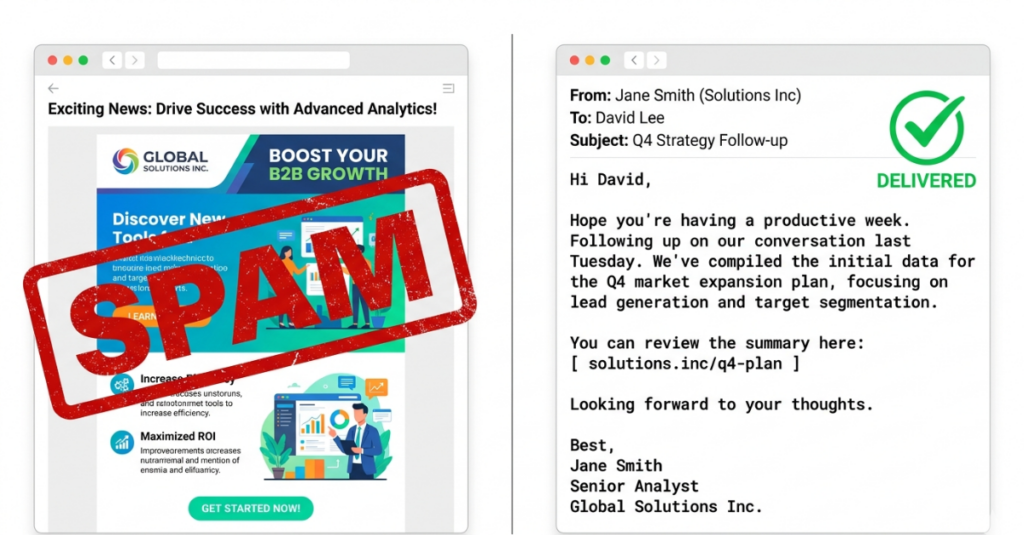
HTML emails, with branded headers, product imagery, and social media icons, are appropriate for marketing. For sales outreach, they are actively counterproductive.
Plain text cold email sends represent the gold standard for B2B cold email mistakes avoidance.
The moment a prospect sees an HTML email from someone they do not know, the mental model is instant: this was sent to ten thousand people. There is nothing personal here. I am not missing anything by deleting it.
That assessment takes under two seconds. And it is almost always correct.
Plain text emails feel like a note from a person. HTML emails feel like a campaign from a marketing team. For cold outreach, the person wins every time.
The fix: Plain text for all cold outreach, no exceptions. HTML also adds file weight that pushes you above 100 KB. It creates the worst possible combination: higher spam risk and lower human engagement if it does get through.
Cold Email Mistake #7: Using the Wrong Sending Infrastructure
This is where many teams inadvertently make everything else worse, often without realising they are breaking rules in the process.
Mass mailing tools like HubSpot, Mailchimp, Marketo, and SendGrid are designed for opted-in subscriber lists using shared public IP addresses. Cold outreach tools like Revnos.AI, SalesLoft, Apollo, Outreach.io, and Lemlist are designed for sending personalised emails from your own configured inbox.
These are not interchangeable. Most mass mailing platforms explicitly prohibit cold outreach in their terms of service. HubSpot’s legal page states that users cannot email recipients who have not consented. Violating this is not just a policy risk: if your unsubscribe rate exceeds two to three percent, your account gets suspended, taking your CRM with it.
Understanding the correct cold email sending infrastructure is critical for avoiding this cold email outreach mistakes category.
The fix: Configure your own email address in a cold outreach tool. Emails go from your inbox to theirs, with your own IP and domain. Volume is intentionally limited to 100–300 per day per address because this is a targeted conversation, not a broadcast.
On infrastructure: Microsoft 365 consistently outperforms Google Workspace for cold outreach deliverability, with Office 365 accounting for roughly 60–65% of business inboxes globally.
Conclusion: Stop Optimising the Wrong Thing
Most cold email mistakes improvement efforts start in the wrong place. Teams focus on copy when the problem is infrastructure. They test subject lines when the emails are not reaching inboxes. Do A/B test CTAs when the file size has already triggered spam filters.
The seven cold email mistakes in this post are not edge cases. They are the default state of most cold email outreach mistakes programs. Most teams commit at least three of them on every send.
The fix is not a new tool or a bigger budget. It is understanding exactly what spam filters look for and removing every reason to flag your email before a human ever sees it. It is understanding what a first cold email is actually supposed to accomplish, and stopping it from doing everything else.
Cold email is not dying. Bad cold email is dying. The ones that get replies are the ones that deserve them.
Run the seven-point self-audit above. Fix what is broken. Then read the companion guide on how to write and sequence the emails themselves.
The reply rates are there. They are just waiting for the fundamentals to be in order.
Frequently Asked Questions
The most common hidden cause is SPF, DKIM, or DMARC misconfiguration on your sending domain. Run your domain through MX Toolbox to check. Even a correctly written, plain-text, well-personalised email will land in spam if the server authentication is not correctly set up. Fix the technical foundation first.
Based on analysis of 43 million emails sent through the Revnos.AI platform, the optimal word count for maximum open rates is 400 to 600 words. Under 400 words does not provide enough space to establish relevance and create curiosity. Over 800 words are unlikely to be read by a stranger. The first email in a sequence should aim for the lower end of this range.
Yes, on two levels. First, most Calendly links are hosted on a third-party domain that neither Google nor Microsoft has a positive trust relationship with, which counts against your deliverability. Second, and more practically, it signals to the human reader that your time is more valuable than theirs. Offer two or three specific time slots in plain text instead. It bypasses the spam penalty and comes across as a human reaching out.
Start with MX Toolbox, which checks SPF, DKIM, DMARC, and spam list status for your domain in seconds. Then send a test email to yourself and download the email file to check its size (must be under 100 KB). Finally, check whether test emails land in your inbox, promotions tab, or spam across Gmail and Outlook accounts. These three checks will catch the majority of deliverability issues before a campaign goes live.

by Kapil Khangaonkar
Published on: June 1, 2026 |
Share: