
Here’s a number from State of Sales that should concern every sales leader about their outbound sales stack.
The average B2B sales rep spends less than 30% of their workweek actually selling.
The rest disappears into CRM updates, data entry, tab-switching across a fragmented sales stack, and the endless hunt for accurate contact information before a single email can go out.
We have spent the last decade automating everything around the conversation. Somehow, we’ve made the actual conversation harder to have.
I’ve spoken with hundreds of sales teams while building Revnos.AI, and almost every one shares the same pattern: they’re not failing at outbound because they lack effort, budget, or talent. They’re failing because the infrastructure beneath their outbound sales stack was never built to work together. It was built to be sold separately.
This is the problem nobody wants in a slide deck. It’s long overdue for an honest conversation.
Broken outbound is rarely a people problem. It is almost always a systems problem.
The Six-Tool Treadmill: How a Fragmented Sales Stack Stalls Outbound
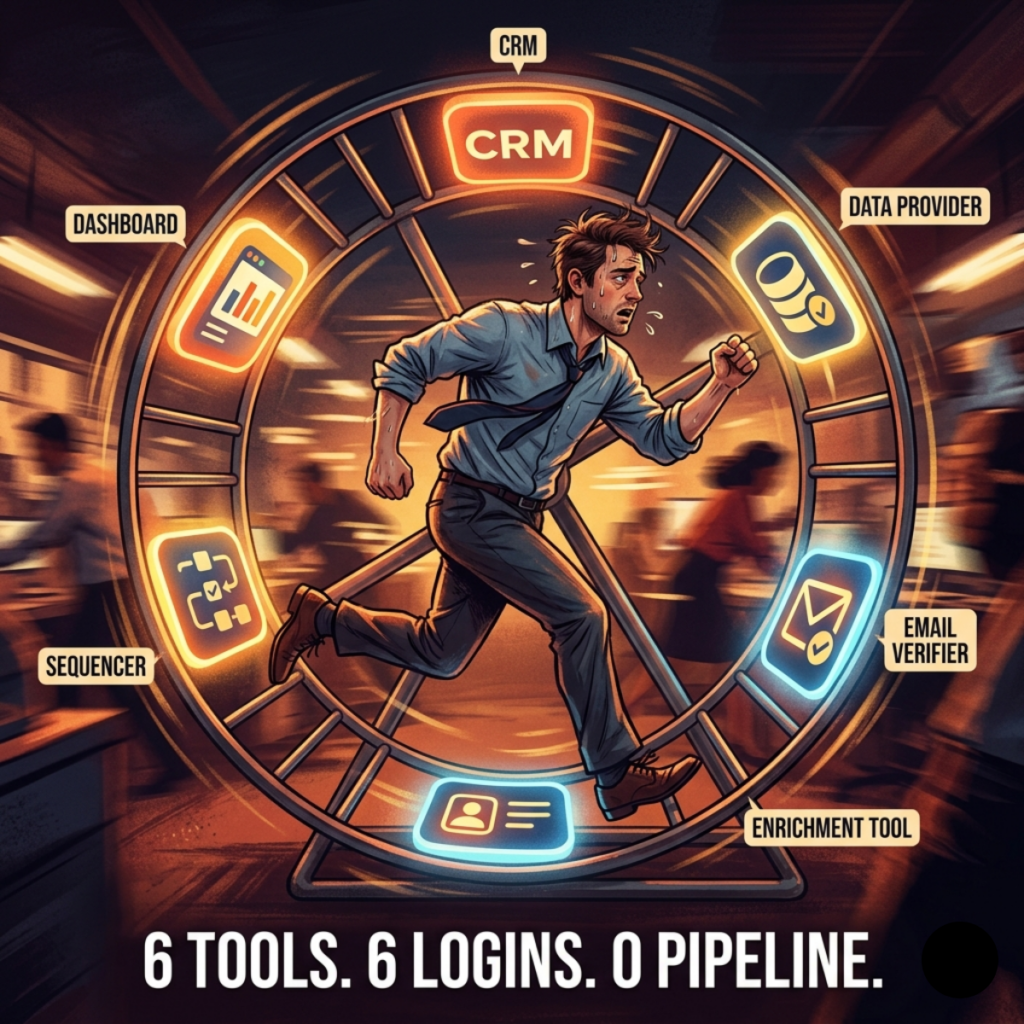
Picture a typical outbound workflow at a mid-sized B2B company. The SDR pulls a target account list from one tool, jumps to a data provider for contacts, runs emails through a verification platform, enriches records in a fourth system, pastes everything into a sequencing tool, and monitors deliverability on a sixth dashboard. Six tools. Six logins. Six opportunities for data to go stale, get lost in export, or be wrong by the time it lands in someone’s inbox.
Salesforce research shows that,
Sales teams now average six or more tools in their daily sales outreach workflow, with that number climbing every year.
Each new tool was supposed to solve a narrow problem. Together, they’ve created a coordination nightmare where the process itself has become the bottleneck. You’ve essentially built a production line where every station runs different software with no shared memory.
The real tragedy isn’t the wasted licensing spend, though at enterprise scale that number is eye-watering. It’s a wasted human attention. Every minute SDRs spend reconciling data across a fragmented sales stack is a minute they’re not spending on the one thing that generates pipeline: actual conversations with buyers.
The Personalisation Lie We’ve All Been Telling Ourselves
Most “personalised” outreach in a broken outbound sales stack isn’t personal at all. It’s automation with better manners.
The industry settled on a definition of personalisation that looks roughly like this: use the prospect’s first name, mention their company, drop in a line about their industry, run it through a sequencer, call it targeted outreach. Buyers in 2026 can identify this playbook in the first two seconds. The “Hey {{FirstName}}, I noticed your company recently expanded into {{Market}}” opener now signals automation before it signals relevance.
Cold email reply rates confirm it. Industry benchmarks have been sliding for years. The average response rate for most B2B outbound sales stack campaigns now sits below 3%. Some teams celebrate a 1.5% reply rate. When one in fifty emails gets a response, something has gone fundamentally wrong, not with timing or frequency, but with depth.

True personalisation isn’t variable insertion. It’s demonstrating that you understand someone’s specific world: their challenges, their priorities, the competitive pressures their business is navigating right now. That’s exactly how AI SDR for outbound should work, context first, built around buyer reality, not template libraries.
What We Built With Atlas: A Unified Outbound Sales Stack
Two years ago, we kept hitting the same ceiling with customers. They’d get the data right, verify the emails, and set up the sequences. Then, campaigns underperformed because the writing, the part that determines whether a prospect reads past the first sentence, was still being done the old way. Either team wrote generic copy at scale, or genuinely good copy for 20 prospects a week when they needed to reach 2,000.
So we built Atlas to attack that exact problem. Not as another point solution to bolt onto a fragmented sales stack, but as an orchestration layer that unifies research, writing, and sequencing from a single starting point.
Here’s how Atlas works in your outbound sales stack: give it a company URL. Within minutes, it has analysed the website, extracted positioning, identified likely pain points, mapped buyer personas, and generated a unique, deeply researched email for each prospect on your list.
We ran a live demonstration with Divyaprasad, our VP of Marketing. He pointed Atlas at a company he used to work at, no briefing, no prep, just a URL. Atlas surfaced six distinct product lines, mapped role-specific ICPs for each, and generated differentiated outreach for every persona. No two emails shared the same angle. That’s the difference between outbound that feels like spam and outbound workflow that feels like someone actually did their homework.
Want to see unified outbound in action?
Watch the Atlas demoWhy Outbound Sequences Fail, and How Atlas Structures Them Differently
Most sales outreach workflow sequences are built on a flawed premise: tell the prospect what you do, ask for a meeting, follow up three times, and give up. It misunderstands how buying decisions actually form.
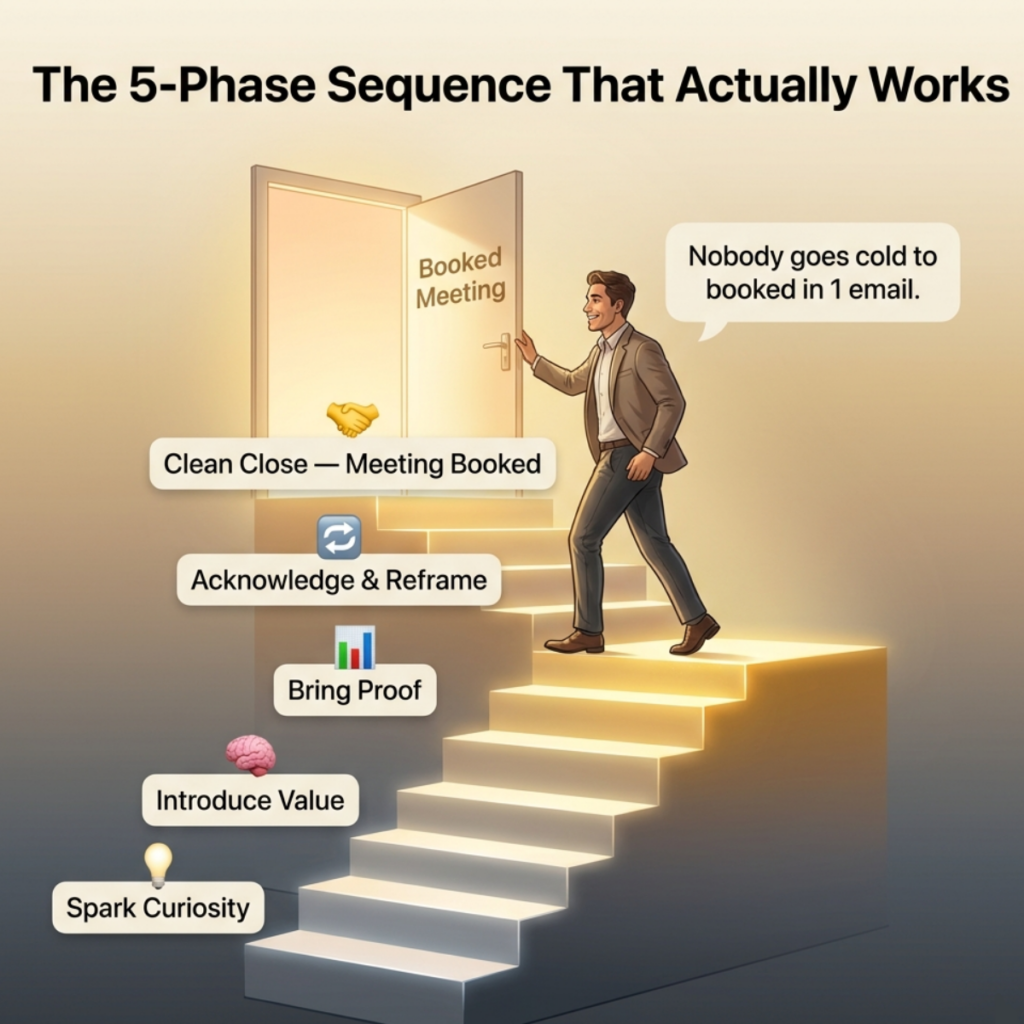
Nobody goes from “I’ve never heard of you” to “let’s book thirty minutes” in a single cold email. What actually moves a prospect toward a conversation is a progressive series of moments where you earn attention before you ask for time. Atlas structures campaigns around a five-phase engagement model that mirrors the psychology of how professional relationships develop:
- Message 1 – Spark curiosity: introduce a tension or observation without pitching anything.
- Message 2 – Introduce value: a relevant insight or framework that signals expertise without demanding a decision.
- Message 3 – Bring proof: a case study, a result, evidence that the value is real.
- Message 4 – Acknowledge and reframe: a thoughtful follow-up that offers an alternative angle without being aggressive.
- Message 5 – Clean close: leave the door open without burning the relationship.
Every message connects to context and speaks directly to a real person. And critically, every piece of communication goes through human review before it scales. A unified AI SDR for outbound does not replace people. It removes repetitive work and helps teams focus on judgment and strategy.
The Operational Shift a Unified Sales Tech Stack Creates
The most underrated benefit of consolidating your outbound sales stack isn’t better emails or higher reply rates, though both matter. It’s what happens to your team’s mental model when the process stops being a series of disconnected tasks and becomes something they can reason about as a whole.
When your data, research, writing, and sequencing all live in one sales tech stack, something shifts. Sales managers can actually diagnose why a campaign is underperforming instead of trying to identify which of six tools introduced the variable that broke results. SDRs stop spending mornings on data hygiene and start thinking about who they want to talk to and why. The feedback loop between what you learn in conversations and how you adjust targeting closes in hours, not weeks.
Teams using Atlas consistently see the reduction in operational overhead eliminate one to two tools from their sales tech stack entirely. But the more lasting change is cultural. When the system handles the mechanical work, the people get to do the human work. That distinction turns out to matter enormously for both morale and results.
This Is Not a Technology Problem; it’s a System Problem
The reason the outbound sales stack is broken isn’t a lack of AI tools or smart people. It’s the incentive structure of the sales technology market, which has historically rewarded fragmentation. Every new point solution makes the integration debt worse, because it solves a narrow problem while adding friction everywhere else.
The answer isn’t a better email tool. It’s rethinking the architecture of how outbound gets done. Unified data, intelligent research, contextual writing, and structured sequencing need to be a single outbound workflow, not four workflows loosely stitched together by CSV exports and Zapier integrations.
Outbound isn’t dying. Decision-makers still respond to outreach that’s relevant, timely, and respectful of their intelligence. What’s dying is tolerance for outreach that is none of those things. Teams that fix their outbound sales stack now will have a structural advantage that gets harder to close with every quarter that passes.
Closing Thought: The Stack Was Never the Sexy Part
Nobody gets into sales because they love tool evaluation. You get in because you like connecting with people, solving real problems, and seeing deals close. The stack was always supposed to be in the background, quietly making that easier.
When it starts demanding more attention than the actual selling, that’s a signal worth taking seriously. Not because you need the latest technology, but because your reps deserve to spend their energy where it actually counts.
The teams I’ve seen get this right aren’t necessarily the ones with the biggest budgets or the most sophisticated tool sets. They’re the ones who asked a straightforward question: is our outbound sales stack set up to help our people sell, or is it getting in the way?
If you’re not sure what the honest answer is for your team, that might be the most useful thing to figure out. Atlas was built for exactly that conversation, and the best way to see whether it fits is to watch it work on a company you already know.
See Atlas work for a company you already know. One URL. Real personas. Real emails.
Book a demoFrequently Asked Questions
An outbound sales stack is the collection of tools and systems your team uses to identify prospects, research them, write outreach, and manage follow-up sequences. It matters because when those tools don’t work together, the coordination overhead alone can consume more than 70% of a rep’s workweek, leaving less than 30% for actual selling.
Having the right individual tools isn’t enough if they’re not connected into a single outbound workflow. A fragmented sales stack means data goes stale between systems, personalisation stays surface-level, and SDRs spend more time on data hygiene than conversations. The bottleneck is usually architectural, not motivational.
Salesforce data shows most B2B teams already use six or more tools in their sales tech stack. The number itself isn’t the problem, the lack of integration between them is. The goal should be consolidating your outbound sales stack so that data, research, writing, and sequencing share a common workflow rather than requiring manual hand-offs between platforms.
Real personalisation in a modern sales outreach workflow means demonstrating understanding of the prospect’s specific business context, their challenges, their competitive pressures, and their priorities right now. Inserting a first name or company name doesn’t achieve that. What works is research-backed, persona-specific messaging that could only have been written for that individual. That’s the standard AI SDR for outbound tools like Atlas are now making achievable at scale.
No. The best AI SDR for outbound tools keeps humans in the loop. They handle the repetitive, mechanical work, research, data enrichment, first-draft copy, so human reps can focus on judgment, relationship-building, and strategy. Every piece of communication still passes through human review before it scales.
If your SDRs are spending significant time each morning on data cleanup, if you can’t clearly diagnose why a specific campaign underperformed, or if onboarding a new rep means training them on five or six different platforms, your sales tech stack is likely creating more friction than it’s removing. A unified outbound sales stack should make campaign diagnosis straightforward and free reps to spend their energy on selling, not system management.

by Kapil Khangaonkar
Published on: June 1, 2026 |
Share: